The other half of planning
Planning is a guess you make in the morning. Reflection grades it: step back to a past day on the dial and see the plan against the day you actually lived.

You make a plan in the morning. You almost never look back on it by night.
That is the strange asymmetry at the heart of most planning. We pour effort into the guess: the careful blocking, the colour-coding, the protected focus hour. Then the day happens to us, and the plan is closed without a second look. Tomorrow we make a fresh guess, with no memory of how the last one held up. We plan forward, constantly, and learn backward, never.
A plan is a hypothesis. It is your best prediction, made under morning optimism, of how the next sixteen hours will go. And like any hypothesis, it is only worth something if you eventually compare it to what happened.
A day leaves a different shape
Here is what you already know in your gut: the day you planned and the day you lived are two different shapes.
The focus hour got eaten by a thread that would not die. Lunch ran long, in a good way. The thing you swore you would do after the kids went down did not happen, again. The plan said one Wednesday; the day drew another. Not because you failed, but because a day is a live thing and a plan is a drawing of it made before it moved.
Most tools have no way to hold both shapes at once. The plan is overwritten by reality the moment reality arrives, or it sits there untouched, a quietly false record of a day that did not go that way. Either way the gap between the two, the most useful thing in the whole exercise, evaporates.
A plan you never look back on is a guess you never grade.
The dial already knows this gesture
The good news is that closing this loop does not ask you to learn anything new.
The dial teaches exactly one move: adjust a wedge. Drag it later, pull its end, change its colour. That single gesture is the whole interface. So when it comes time to say how the day actually went, there is nothing to invent. The day you planned is still there on the ring, only now each block is a faint ghost of itself, the plan held in place. Reflecting is just bringing those ghosts into line with reality.
You go block by block and answer one small question for each: did this happen the way I drew it?
- As planned. It landed where you put it. One tap, move on.
- Didn’t happen. The focus hour never came. Mark it, no guilt, it is data.
- Changed. It happened, but not like that. The ghost stays as the plan; you drop a solid block where it really sat, and now the ring carries both: intention and reality, one over the other.
It is the same drag, the same dial, the same muscle memory you use to plan. Looking back costs you almost nothing because you are not filling in a journal. You are just nudging the wedges until the picture is honest.
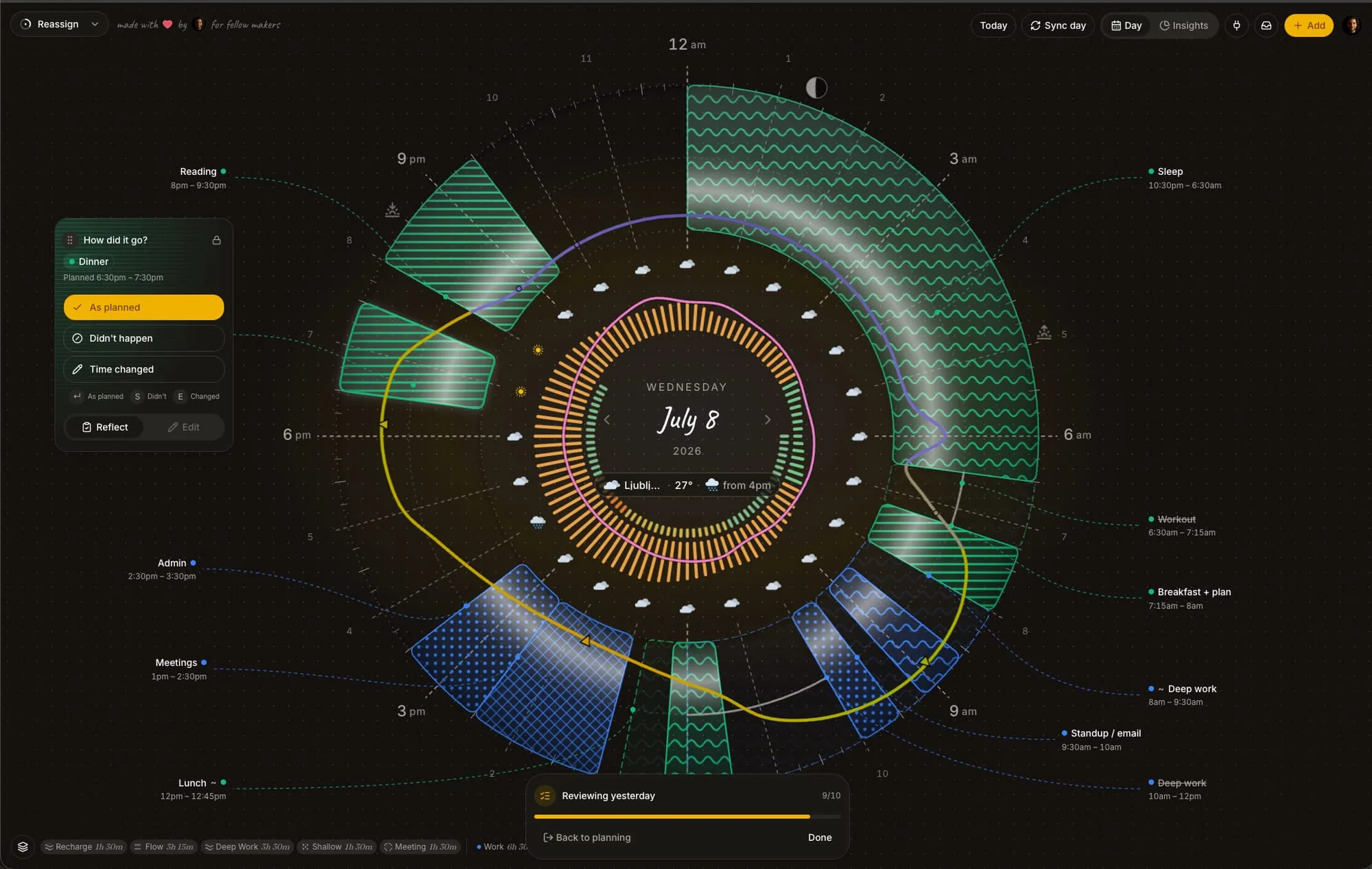
The gap between plan and reality is the whole point
Once both shapes sit on the same face, the thing you came for is right there in the negative space between them.
The delta between the plan and the lived day is the signal. It is where the self-knowledge lives. Reflect a few days running and patterns surface that no amount of forward planning could have told you: the morning focus block that gets devoured four days in five, so maybe it belongs in the evening. The “quick” admin task that always doubles. The family hours that, it turns out, you actually keep. You stop planning against an imaginary version of yourself and start planning for the one the data describes.
This is the loop the product is built around, and it only closes when you look back:
plan it → live it → look back → plan a truer day → and round again.
Notice the day, don’t score it
There is an obvious trap here, and it is worth naming because we deliberately avoided it.
The moment you turn reflection into a score, you have ruined it. A big number for “stuck to the plan” sounds motivating and is in fact poison: it quietly trains you to mark everything As planned, to draw timid plans you know you will hit, to lie to your own dial. The score goes up and the honesty, the only thing of value, goes down.
So reflection rewards the act, never the height. It celebrates that you looked back, that you were honest, that the truer plan is taking shape over weeks. A day where nothing went to plan but you marked it truthfully is a better day, by the only measure that matters here, than a day you rounded up to feel good. The point is not to obey the morning. It is to learn from the evening.
Closing the loop: review your day, plan a truer one
Reflecting on yesterday is free, no Pro required, because half the value of a planner is knowing whether the plan was any good. Pro reaches further back, for when you want to read a whole week or month at once. And because Reassign is also an MCP server, you do not have to do it by hand: ask Claude “how did yesterday go?” and it reads the plan against the lived day through the review_day tool, right in the chat.
We spend our mornings deciding what the day should be. Reflection is the small, honest habit of finding out what it was, so the next guess is a little less of a guess. It is the other half of planning, and for most of us it has been missing the whole time.
Want to see where this is headed? The roadmap has what is next. Or close your own loop tomorrow: get your day out of your head and onto the dial.
Frequently asked
- What is day reflection in Reassign?
- Day reflection lets you step back to a past day on the 24-hour dial, where each planned block appears as a faint ghost of itself, and mark how it actually went: As planned, Didn't happen, or Changed (with the real time if it moved). The marks roll up into a quiet read of how closely you lived your plan.
- Is reflecting on your day free?
- Yes. Looking back at yesterday is free, no Pro needed. Pro reaches further into the past so you can reflect on older days too.
- Can Claude review my day for me?
- Yes. Reassign exposes a review_day tool over MCP, so you can ask Claude "how did yesterday actually go?" and it reads your plan against the day you lived, right in the chat.
- Does a high adherence score matter?
- No, and that's deliberate. Reflection rewards looking back and being honest, never a high score. Rewarding adherence would just push you to mark everything "as planned," which would corrupt the very signal the feature exists to capture.
- Does reflecting on your day help with ADHD?
- Many people with ADHD lose track of whether the plan actually happened. Reflection answers "did I do what I planned?" by showing each block's intention against the real day, with no score to game, just an honest picture you can plan the next day from.