The dial keeps count
Reassign now tracks moments on the 24-hour dial: log a coffee, a glass of water, or your mood as points in time, and read each day's total in the legend.

A planner is good at one question: what should happen, and for how long? You draw a block, give it a start and an end, and the day fills with spans. That is the whole grammar of planning, duration laid out in order.
But not everything in a day has a length. Some of it is just a point. The coffee you had at 8:14. The moment, somewhere after lunch, when your mood quietly fell. The third glass of water, or the one you forgot. These are facts with a timestamp and nothing more. They have no duration to block out, no end to drag. A planner built only for spans has nowhere to put them, so they go unrecorded, and a real and useful layer of the day disappears.
A clock is the natural home for an instant
Here is the thing a 24-hour dial gives you for free: it is a clock. Every position on the ring already means a time. Noon is the bottom, midnight the top, and 8:14 in the morning is a specific, findable angle whether or not anything is planned there.
So a point in time has an obvious place to live. Not a block stretched thin, but a single mark on the bezel, sitting at exactly the hour it happened. A coffee becomes a tick. A mood becomes a dot on a red-to-green face. You drop it at the time it occurred, or just tap to log it now, and it lands where it belongs on the ring. Drag it and it slides to a new minute. The dial was already a timeline; a moment is just the smallest possible thing you can put on it.
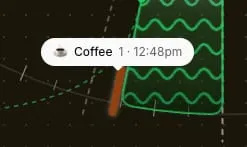
A block answers for how long. A moment answers when.
Plan, lived, counted
The dial has been collecting layers of the same day. First the day you plan: blocks of intention laid out in the morning. Then, with reflection, the day you lived: the ghost of the plan with reality drawn over it. Moments add a third reading, quieter than both: the day you counted. Not what you meant to do, not how it actually went, but the small discrete facts of it, scattered through the hours where they fell.
And crucially, this layer keeps to itself. A moment is not a planner event wearing a different hat. It takes no time, blocks no slot, joins no plan and skews no reflection. It rides on the same ring as your blocks without ever competing with them, so tracking your water never crowds out planning your afternoon. You get the data without paying for it in clutter.
Marks become a number
A single tick is an anecdote. A column of them is a habit.
The point of logging coffee is not the one cup; it is the count by evening. So the dial’s legend totals each moment for the day. It tallies what you count (five coffees, three glasses of water), averages what you rate (your mood across the day), and sums the quantities. The scattered marks on the ring collapse into one number, and a day of small logs becomes something you can actually read.
Do it across days and the same shift happens that reflection gives you: a pattern you could not have guessed surfaces on its own. The afternoon your mood reliably dips. The days the water never gets past two. The coffee that creeps later than you thought. You were not keeping score. You were just dropping marks where they fell, and the dial kept the count.
Start with how you feel
Mood is built in and free, the one moment everyone gets out of the box: tap the day’s face from red through green and it lands on the ring like any other mark. It is the gentlest possible place to start, one tick, no setup. From there you make your own: name a thing worth counting, give it a colour, and it joins the dial. Tracking your own moments is part of Pro.
It is a small feature with a quiet ambition. Most of what shapes a day never makes it into the plan, because the plan only had room for blocks. Now the dial has room for the rest of it too, the points as well as the spans.
Want to see where this is headed? The roadmap has what is next. Or start counting your own day: open the dial and drop your first mark.
Frequently asked
- What are moments in Reassign?
- Moments are discrete things you log as points in time on the 24-hour dial, like a coffee, a glass of water, or how you feel. Unlike a planned block, a moment has no duration and never blocks your time: it is a single mark on the ring at the moment it happened, which you can drag to re-time or click to edit.
- Is moment tracking free?
- Mood is free for everyone, a built-in moment you rate on a red-to-green face. Tracking your own custom moments, water, caffeine, anything you want to count, is part of Pro.
- What can I track as a moment?
- Anything countable that happens at a point in time: cups of coffee, glasses of water, a mood, a cigarette, a dose, a set of reps. You create the moment, give it a colour and a name, and log it through the day.
- How is a moment different from an event on the dial?
- An event is a block: it has a start, an end, and it occupies a span of your day. A moment is an instant: a single tick on the ring with no duration, that never takes time or blocks a plan. The two live on the same dial without getting in each other's way.
- Can I see a total for what I track?
- Yes. The dial's legend shows a daily figure for each moment, a tally of how many times you logged it, an average for a rating like mood, or a total for a quantity, so a day of scattered marks reads as a single number.
- Can I track habits or moods in a day planner?
- Yes. In Reassign, habit and mood tracking live on the same 24-hour dial you plan on. Log a moment each time something happens, a glass of water, a coffee, a cigarette, or rate your mood, and the dial keeps the count: a daily tally for habits, an average for mood. There is no separate app to open.