Why a day is round
A list flattens time. A dial shows its shape. On the 24-hour clock as the oldest, most legible interface we have for a day.

Open any to-do app and your day arrives as a column. Tasks stacked top to bottom, each the same height, each the same weight. It is a tidy way to remember what you meant to do. It is a terrible way to see a day.
Because a list throws away the one thing a day actually has: shape. A list cannot show you that your morning is packed and your afternoon is hollow. It cannot show you the long quiet hour after lunch, or that the gap before dinner is barely enough for a walk. It tells you what, never where. And “where” (where in the day a thing sits, what it leans against, how much room is left around it) is most of what planning is.
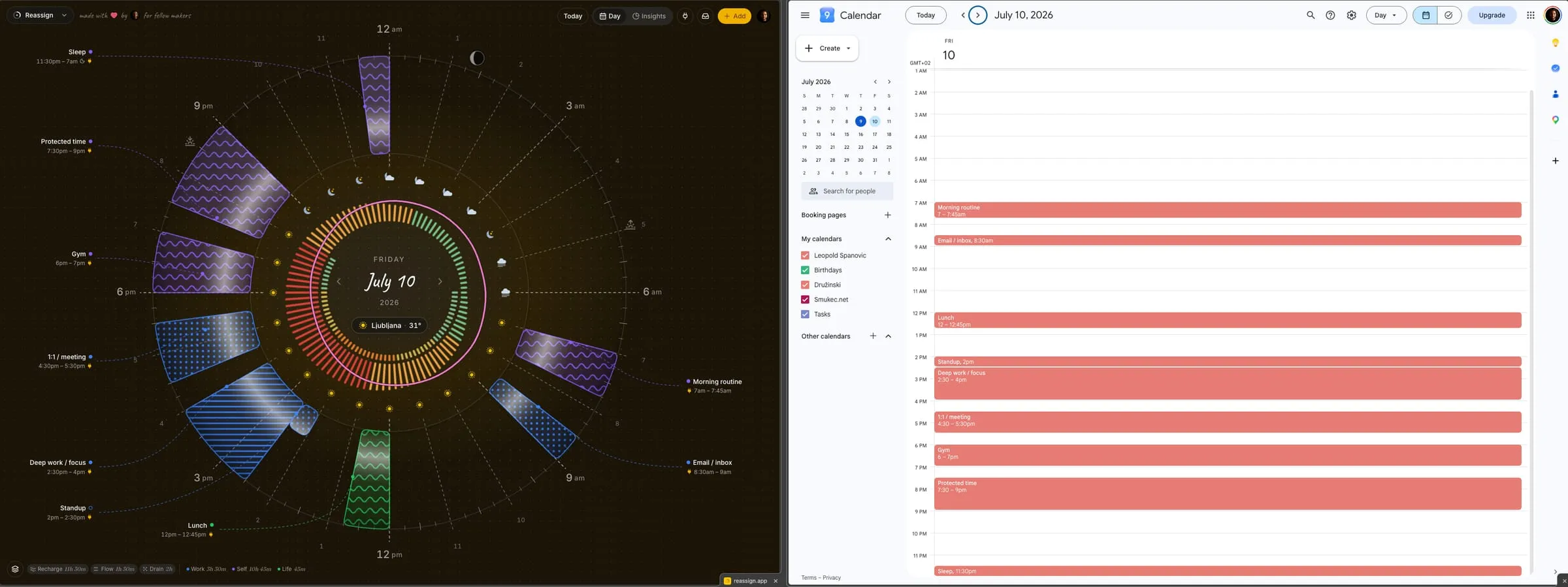
A line pretending to be a day
Calendars do a little better. They give time a vertical axis, so at least 9am sits above noon. But a calendar is still a strip: a line you scroll. Midnight is severed from midnight. The day breaks at the top and bottom of the screen, exactly where your real day doesn’t break at all. You wake, the strip starts; you sleep, the strip ends. The hours you spend not looking at the calendar fall off the edge.
The trouble is that a day isn’t a line. A day returns. The same hours come back tomorrow, in the same order, in the same proportions. Morning always leans toward noon; evening always tips into night. That returning, that closing of the loop, is the most basic fact about a day. It’s the first thing a list or a strip throws away.
The oldest interface we have
Here is the quiet joke: we already solved this, thousands of years ago, and then put it on the wall and stopped looking at it.
The clock face is round because the thing it measures comes back around. A sundial is round for the same reason: the shadow sweeps an arc because the sun does. Long before anyone wrote a task on a list, people read the day off a circle. The round clock is arguably the oldest, most widely legible interface humanity has ever agreed on: a child can read “halfway round” as “halfway through” without being taught. Notebook people keep rediscovering it too; the hand-drawn clock-face planner even has a name, the chronodex.
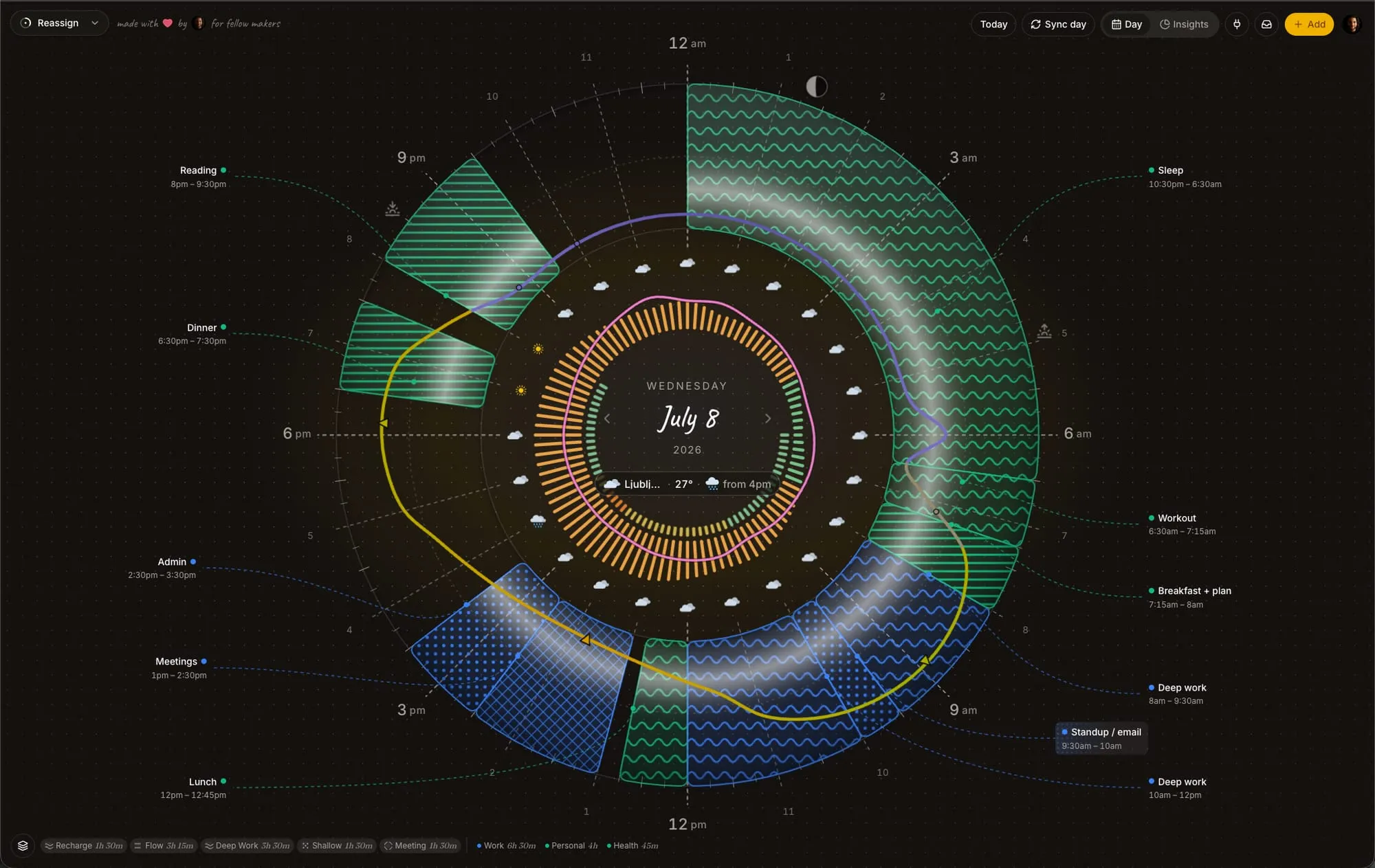
So we lean on it. In Reassign, your whole day is a single 24-hour dial: midnight at the top, noon at the bottom, the hours sweeping round once. Not twelve hours doubled, not a strip you scroll. One face. The entire day, at a glance, the way the day actually is.
A list tells you what you owe the day. A dial tells you what the day has left.
What the shape gives back
When time has a shape, things you used to compute become things you simply see:
- Fullness. A crowded morning looks crowded: a thick band of blocks around the top of the dial. An open afternoon looks open. You read your own week’s worth of load in a glance, no arithmetic.
- Balance. Because midnight sits opposite noon, the dial quietly answers a question lists never could: how does the first half of my day weigh against the second? Where is the day lopsided?
- The negative space. On a list, free time is invisible, the mere absence of a line. On the dial, free time is a shape: a wedge of open ring you can point at, measure with your eye, and fill. The gaps stop being nothing and start being room.
That last one matters most. A planner that only shows you your commitments is a worry machine. A planner that shows you your openings, as honest, lookable space, is something you can actually plan into.
Drawing instead of listing
Once the day has a shape, you stop typing it and start drawing it. You drag from 7:30 to 9 and a block appears on the ring. Plans move, so you grab that block and slide it later, or pull its end to make it longer. The day bends instead of breaking.
It turns out that the act of drawing your day onto its real shape is a different kind of thinking than listing it. Listing asks, “what do I have to do?” Drawing asks, “what will this day actually be like?” The first is a ledger. The second is a plan.
The day was always round. We got used to reading it flat. Reassign is the small, stubborn argument that you should give time back its shape, and then plan on the shape the day already has.
And because a round face has room for every source at once, it’s also the one surface that can hold the calendars already scattered across your other apps. That’s the next step: bringing every calendar onto one dial.
Frequently asked
- What is circular day planning?
- Circular day planning lays your whole day out on a 24-hour clock face instead of a scrolling list or column. Because the face is round, you see the day's actual shape (where it's crowded, where it's open, how morning weighs against evening) at a single glance.
- Why is a circular planner better than a to-do list?
- A list tells you what you have to do but not where in the day anything sits. A dial shows fullness, balance, and free time as visible shapes, so questions you used to compute ("do I have room before dinner?") become things you simply see.
- How does a 24-hour dial differ from a normal calendar view?
- A calendar is still a strip you scroll, so the day breaks at the top and bottom of the screen and midnight is severed from midnight. A 24-hour dial closes the loop (midnight at the top, noon at the bottom), showing the entire day as one continuous face, including the hours a scrolling view pushes off the edge.
- Why does Reassign put midnight at the top of the dial?
- With midnight at the top and noon at the bottom, the two halves of the day sit opposite each other, so the dial reads like a sundial's sweep, where the hours come around once, in order, and you can weigh morning against evening in one look.