The chronodex: a day planned on a clock face
A chronodex is a planner drawn as a clock face: hours as sectors, tasks as shaded wedges. What it is, how to use one, and where paper runs out.

Every few months, someone sketches their day as a circle and posts it. The replies are always the same two questions. What is this called? And: please, show me one filled out.
It has a name. The clock-face planner is called a chronodex, and people have been independently reinventing it for as long as days have refused to behave like lists. This post is the answer to both questions: what the thing is called, and what a filled-out one actually looks like.
What is a chronodex?
A chronodex is a time-management diagram drawn as a clock face. The hours radiate from a centre; your day is recorded by shading sectors of the circle, one wedge per block of time. A two-hour focus session is a wide wedge. A fifteen-minute call is a sliver. The page stops being a list of what and becomes a picture of when.
That is the entire trick, and it is a good one. Duration becomes size. Time of day becomes position. The day gets to keep its shape.
Where it came from
The chronodex was designed by Patrick Ng, a Hong Kong stationery obsessive, who published it on his blog Scription in 2011 as a free printable insert for the Traveler’s Notebook. It spread through the bullet-journal world from there, and by 2013 had inspired a spiral variant from another hand: the spiraldex, which coils the hours outward from the centre in one continuous spiral instead of a stylised clock face.
Neither needed marketing. People kept finding them the same way: by hitting the limits of the list, going looking for something round, and discovering a small community that had already been quietly shading circles for years.
How to use a chronodex
The method is the same on paper and on a screen, and it runs in one direction: fixed first, chosen second.
- Anchor the immovable hours. Sleep, work, the school run, the standing meeting. Shade their sectors first. They were never really negotiable, so let them claim their wedges up front.
- Draw in what you choose to do. Deep work, the gym, the side project, dinner. Size each wedge to the time the thing actually takes, not the time you wish it took.
- Colour-code by area of life if it helps: one colour for the day job, one for family, one for you. The balance of the day becomes readable at arm’s length.
- Leave the empty ring empty. The unshaded arc is the honest picture of your free time. On a list, free time is invisible. On the circle, it is a shape you can point at.
Why a clock face beats a list
A list is a tidy way to remember what you meant to do and a terrible way to see a day. Ask anyone who plans in circles why they switched and you hear the same phrase: the list was a wall of text. Every task the same height, every hour implied, the afternoon already gone by the time you reread the morning.
The circle fixes what the column cannot. A day is round: the same hours come back tomorrow, in the same order, and a clock face is the oldest interface humanity has for that fact. And for ADHD brains in particular, the wedge does the one job a list refuses to do: it makes duration visible instead of asking a time-blind brain to feel it. We wrote about that mechanism in detail in the circular planner for ADHD. Some brains even see time this way unprompted, a trait called spatial-sequence synesthesia.
A list tells you what you owe the day. A chronodex tells you where the day went, and what it has left.
Where paper runs out
The paper chronodex is a lovely object with three honest limits.
Twelve hours, twice. A clock face holds half a day, so morning and evening share the same sectors. The stepped design keeps two laps readable, but you are still folding twenty-four hours onto twelve, and the fold is where reading errors live.
Plans change; ink does not. The meeting runs long, lunch slides, and your carefully shaded 2pm wedge is now a lie. The most common question about circular planners is not how do I start one, it is how do I update one. On paper the answer is an eraser, which is why so many chronodex pages are beautiful until about 11am.
Nobody shows you a filled-out one. Blank templates are everywhere. Worked examples are rare, which keeps the whole format feeling like a secret handshake.
A digital chronodex that updates itself
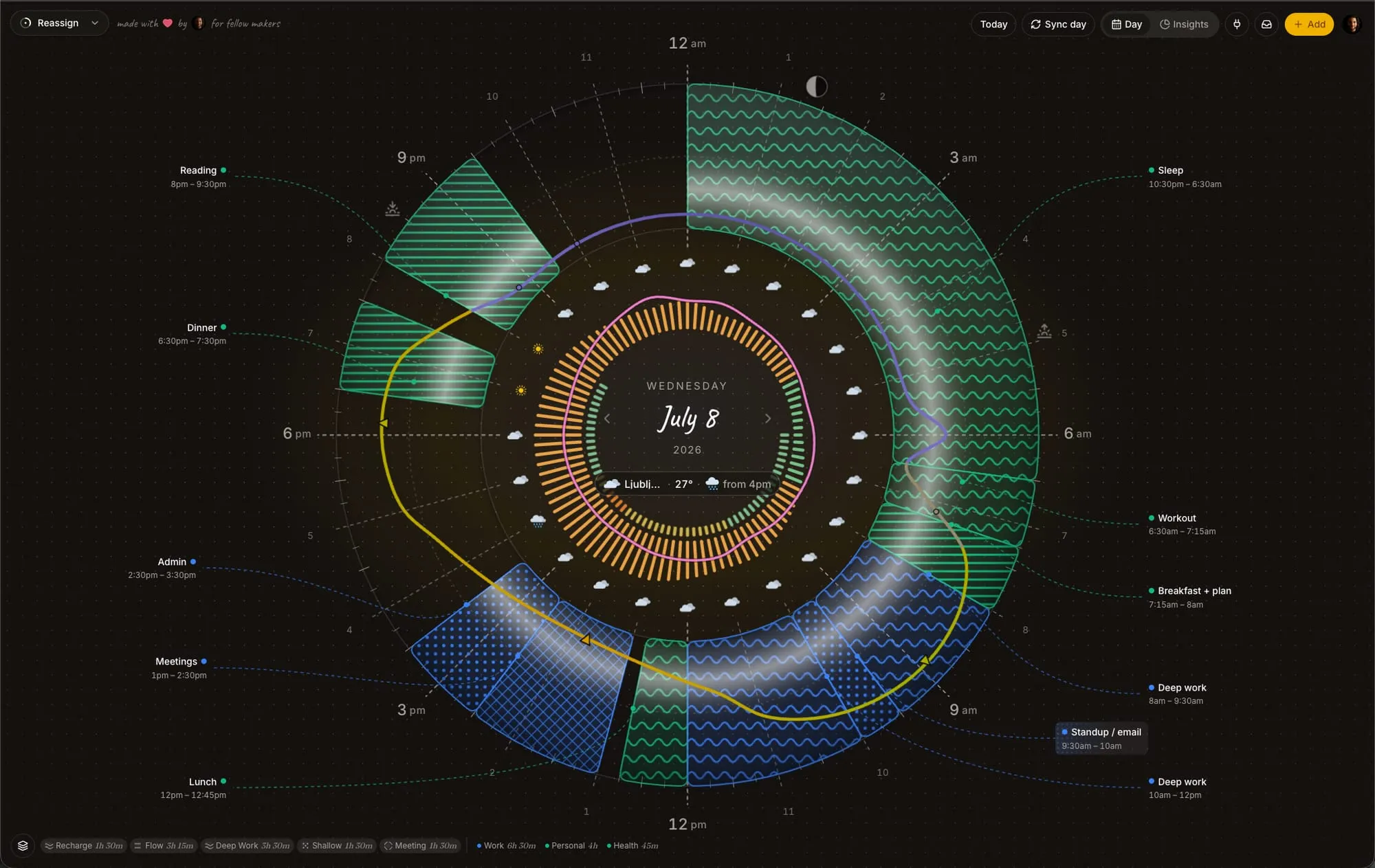
Those three limits are exactly what a digital circle exists to remove. Reassign is a chronodex grown into a full planner: one 24-hour dial (midnight at the top, noon at the bottom, no folding), blocks you draw by dragging, and a plan that bends when the day does. When one thing runs long, you move the rest of the day in a single gesture instead of reaching for the eraser:
It is not the only digital circle. Sectograph puts your existing calendar on an Android clock widget; Tiimo wraps routines in circular timers; the Time Timer has been shrinking its red disk on classroom walls for decades. They all run on the same insight the chronodex named: time you can see is time you can use.
If you have ever shaded a clock face in a notebook and wished it would shade itself back when the day moved, that is the planner we built. Reassign is free to start, and the circle is already drawn: try it free.
Frequently asked
- What is a chronodex planner?
- A chronodex is a time-management diagram drawn as a clock face. Instead of listing tasks in a column, you shade sectors of a circle for each block of your day, so duration shows up as the size of the wedge and the whole day reads as one shape. It began as a free printable insert for paper notebooks and the same idea now exists as digital 24-hour planners.
- How does a circular planner work?
- A circular planner lays the day out on a round dial instead of a column. The hours sit around the face like a clock, and you block time by shading or dragging wedges onto the ring, each sized to its real duration. Fullness, gaps, and balance become visible shapes instead of lines of text.
- How do you use a chronodex?
- Anchor the fixed parts of your day first (sleep, work hours, standing meetings) by shading their sectors on the clock face. Then draw the things you choose to do into the space that is left, sized to how long they really take. Colour-code by area of life if it helps. The unshaded ring is your actual free time, visible as shape.
- What is the difference between a chronodex and a spiraldex?
- Both draw the day as a circle. A chronodex is a stylised 12-hour clock face where sectors step in and out so two laps round the dial stay readable. A spiraldex coils the hours outward from the centre in a spiral, one continuous line from waking to sleep. The chronodex is the better-known of the two.
- Is there a digital chronodex app?
- Yes, several. Reassign is a 24-hour circular day planner in the browser: the chronodex idea with drag-to-draw blocks, calendar sync, and a plan you can slide when the day moves. Sectograph projects your existing calendar onto a clock-face widget, and Tiimo builds visual routines around circular timers.
- How do you update a circular planner when plans change?
- On paper, you erase or redraw, which is why many chronodex pages get abandoned by noon. A digital circular planner updates by direct manipulation: drag a block to a new hour, pull its edge to resize it, or shift it and everything after it down the dial in one move.