Circular Planner for ADHD: Why a Round Day Beats a List
ADHD brains struggle with linear lists and time blindness. A 24-hour circular planner makes time visible as shape, so you see your day instead of reading it.

There is a particular kind of grief that lives inside an unfinished to-do list. You open it at four in the afternoon and the day has happened to you instead of with you. The same six items still there, slightly accusing, the hours behind them already spent. The list never told you they were being spent. That is the thing a list cannot do.
For ADHD brains in particular, the linear list is a quietly hostile object. It assumes a sense of time the reader does not have. The thing that helps is not a better list. It is a different shape. A circular planner for ADHD trades the column for a 24-hour dial, the day rendered the way it actually behaves, which is round.
What a circular planner actually is
Circular planning is a way of laying out your day on a clock-shaped dial instead of in a vertical list. The full twenty-four hours appear at once, as a ring; tasks become wedges of colour on that ring, sized to their real duration and placed in their real position. The interface stops being a ledger of what and becomes a picture of when. Paper planners have carried the same idea for years under the name chronodex.
The takeaway: a list shows you what you owe. A dial shows you what the day has left.
Why linear to-do lists fail ADHD brains
Lists fail ADHD readers because they flatten the one thing a day actually has, which is shape, and they assume a kind of time perception ADHD reliably under-supplies.
The technical name is time blindness. The psychologist Russell Barkley has called it a kind of nearsightedness to the future, where things further out than a few minutes lose their pull, and durations between them collapse. The clinical-coaching shorthand for this is now and not-now. There are only two times in an ADHD day, and “not-now” is where most of the day quietly lives, and dies. A list, with its identical-height rows, gives no clue which line is half an hour away and which is the rest of your life. Everything reads as not-now until it is suddenly, painfully now.
This is also why columns of text are so easy to abandon. Out of sight is genuinely out of mind. The fourth item down has already stopped existing by the time you’ve reread the first one. To give time back its shape is to stop relying on a faculty the ADHD brain doesn’t have, and start relying on one it does: vision. Some brains even volunteer the shape on their own, seeing the year as a ring and the week as a line; that trait is spatial-sequence synesthesia, and it arrives at the same conclusion from the opposite direction.
How a 24-hour dial answers time blindness
A dial answers time blindness by moving the work of feeling the hour into the act of seeing it. Four mechanisms do most of that, and they compound.
The dial externalises time perception. A list assumes you can sense how long an hour is. The dial doesn’t ask you to; it shows the hour as a slice of ring. The shape is the duration. ADHD brains do not need to estimate what they can already see, and that is the only durable way to plan around a perception you can’t trust.
The ring restores object permanence to the day. On a list, anything below the fold has quietly ceased to exist. On the dial, nothing scrolls. Six p.m. is always present, ninety degrees from wherever you are standing in the day. The afternoon cannot fall off the edge, because there is no edge.
It is 2:14pm. You realise you have not eaten. On a list, lunch is a missed line. On the dial, it is a fat empty arc between noon and two, and you can see, without counting, that there is still a clean half-hour wedge before your three o’clock.
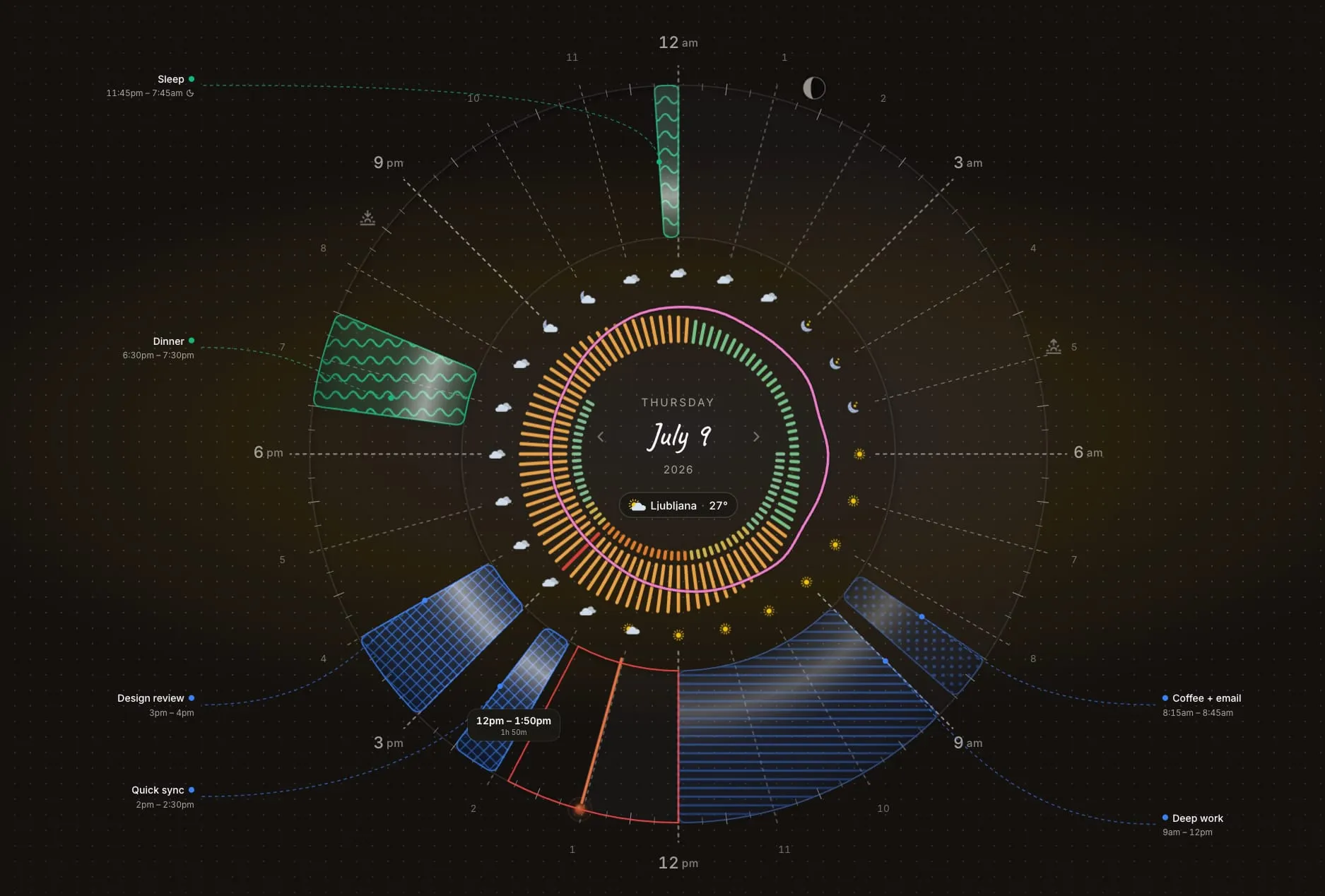
Negative space lowers the cost of starting. A list shows what you owe; the dial shows what is left. That wedge of open ring is the thing ADHD readers most need and most rarely get: visible permission to begin a small thing, because the small thing visibly fits. Task initiation is half a perception problem, and the dial answers it before willpower has to.
Drawing is a dopamine-friendlier interaction than typing. Dragging a block, watching it land on the ring, stretching its edge: the motor loop and the visual payoff are immediate. Planning becomes a thing your hands want to do, which is the only kind of planning an ADHD brain reliably returns to.
Is circular planning the same as time blocking?
Yes, with a difference that matters. Time blocking gives a task a duration; circular planning gives it a duration and a shape and a position. A two-hour block on a list is still a line; on the dial it is a wedge that visibly leans against lunch on one side and the school run on the other. You can see whether it survives the day around it. Time blocking on a circle is the same idea finally rendered in the medium the day already uses, which is why it tends to protect an unbroken block that a list would let fragment.
Starting a day on the circle
The first day on Reassign is mostly subtraction. You drop in the fixed shapes (sleep, work hours, the school run, the standing meeting) and let them claim their wedges. What remains is visible time, which is a different feeling from the abstract “free afternoon” of a list. Then you draw the things you actually want to do into the space that exists for them, at the size they need.
The day will move. It always does. So you grab a block and slide it, or pull its end shorter, and watch the ring rearrange itself around the change. Or you ask your AI out loud, “move everything after lunch back an hour, I’m fried,” and the blocks slide and the afternoon rotates. You did not have to re-plan; you only had to describe the version of the day you could actually do.
None of this fixes executive function. The dial doesn’t make tasks easier or quieter or less plentiful. It makes time visible, which is the single thing ADHD planning most needs, and the single thing a list cannot do.
If your day keeps disappearing into a list, you might find it easier to draw. Reassign is a circular planner for ADHD, and you can try it free. Want to weigh the field first? We compared the best apps for time blindness honestly, ours among them. No urgency. The day will be round tomorrow either way.
Frequently asked
- Is there a planner designed for ADHD?
- Yes. Circular planners like Reassign render the full day as a 24-hour dial, which externalises time perception, the part ADHD brains most reliably under-supply. Tasks become wedges of colour on the ring rather than identical-height lines in a column.
- Why are to-do lists bad for ADHD?
- Lists assume the reader can sense duration and remember items that have scrolled out of view. ADHD brains often can't do either reliably, so lists turn most of the day into "not-now": invisible, easy to miss, and easy to abandon.
- What is the best visual planner for ADHD time blindness?
- The most direct visual answer to time blindness is a 24-hour circular planner, because it shows duration as shape on a single dial. You stop estimating how long things will take and start seeing it.
- Does time blocking work for ADHD?
- It works much better when the blocks have a shape you can see, not just a duration you have to imagine. Circular time blocking lets you watch a protected block survive (or fracture) against the rest of the day, which is something a list or a vertical strip can't show.
- What is a 24-hour clock planner?
- A 24-hour clock planner is a planner that lays out the entire day as one continuous round dial, midnight at the top, noon at the bottom, with tasks placed as arcs on the ring. The whole day is visible at once, which makes it easier to plan into the gaps instead of through them.