Time blindness: the hours you can't feel
Time blindness: when you cannot feel time passing. Hours vanish, deadlines ambush you. What it is, how it ties to ADHD, and how to make time visible.

There are two classic ways it goes. Either the 2pm meeting ambushes you, somehow, at 2pm, despite being on the calendar all day. Or you sit down at nine to fix one small thing, look up, and the morning is gone. Not wasted. Gone. Missing from the record.
If both of those feel less like anecdotes and more like your operating system, there is a name for it: time blindness.
What is time blindness?
Time blindness is a persistent difficulty sensing time: how much has passed, how much is left, how long things actually take. Most people carry a rough internal clock. It hums along in the background, nudging them: it’s been an hour, wrap up, leave now. Time blindness is what life looks like when that clock doesn’t hum.
The term was popularized by Dr. Russell Barkley, one of the most cited ADHD researchers alive, whose unifying theory of ADHD argues it is not fundamentally an attention problem at all. It is a time problem. His phrase is nearsightedness to time: the future is blurry, so only the near-at-hand feels real. His conclusion about what a person with ADHD is up against is blunt: they know what to do, but the when keeps slipping through their fingers.
To be precise about the label: time blindness is not an official diagnosis. You won’t find it in the DSM. It is clinical shorthand for something researchers measure all the time in ADHD studies: consistent differences in estimating intervals, reproducing durations, and judging how much time a task will swallow. The shorthand stuck because it describes the felt experience better than any scale score does.
Time blindness symptoms: what it looks like from the inside
Time blindness rarely announces itself as “I cannot perceive temporal intervals.” It shows up as a pattern of weirdly specific, weirdly universal experiences.
- Now and not-now. The day divides into exactly two time zones. A deadline is either not now, which means it does not exist, or now, which means it is an emergency. There is nothing in between, which is where planning is supposed to live.
- Waiting mode. A 3pm appointment doesn’t cost you 30 minutes. It costs you the whole day, because starting anything before it feels impossible. The appointment sits on the horizon like weather, and you watch it.
- Hyperfocus swallows hours whole. Inside a task you love, time does not pass slowly or quickly. It does not pass at all. Then it is dark outside.
- Time optimism. Every plan is built for a version of the day with 30 hours in it. “Quick shower” is either five minutes or fifty, and you genuinely cannot tell which one just happened.
- Late, or absurdly early. Some people run chronically late. Others, burned enough times, overcorrect and arrive 40 minutes early to everything, paying for punctuality with the same lost hours.
One more, quieter than the rest: the past thins out. When you can’t feel time, last Tuesday and last month sit at the same distance. People assume the day just vanished. It didn’t. It happened. Nobody was keeping the ledger.
Is time blindness a symptom of ADHD?
Strongly, yes. But not only ADHD, and it is worth being honest about the boundaries. Autistic people report it. Depression and anxiety distort time perception in their own directions. And every human on earth runs a mild version: psychologists call it the planning fallacy, our stubborn habit of underestimating how long things take even when we have done the exact thing before. Kahneman and Tversky named it in 1979, and the classic study watched students miss their own thesis estimates by three weeks, with full confidence, twice. Your kitchen renovation replicated it.
The difference in ADHD is dose and persistence. The estimation errors are larger, they don’t improve much with feedback, and they compound across a day. A neurotypical brain misjudges one task and course-corrects. A time-blind brain misjudges the task, misses the drift, and meets the consequences all at once, at 4pm, as a wall.
Two practical notes before the toolkit. First, none of this is a diagnosis. If these patterns run your life and keep costing you real things, jobs, relationships, sleep, an ADHD assessment is worth raising with a clinician: a planner is a prosthetic, not treatment. Second, you cannot train your way into feeling time. The working strategies all point the same direction, and it is outward.
A to-do list is the wrong prosthetic
Here is the part most advice skips. The standard tool we hand people for managing a day, the to-do list, is close to the worst possible interface for a time-blind brain.
A list renders what and hides when. Every item is one row tall. “Send the invoice” and “prepare the workshop” occupy identical space on the screen, so the list quietly asserts they are the same size. Duration, the exact dimension a time-blind brain cannot supply internally, is the one dimension a list refuses to draw. You are being asked to feel the difference between a 5-minute task and a 3-hour task. Feeling it is the thing you cannot do.
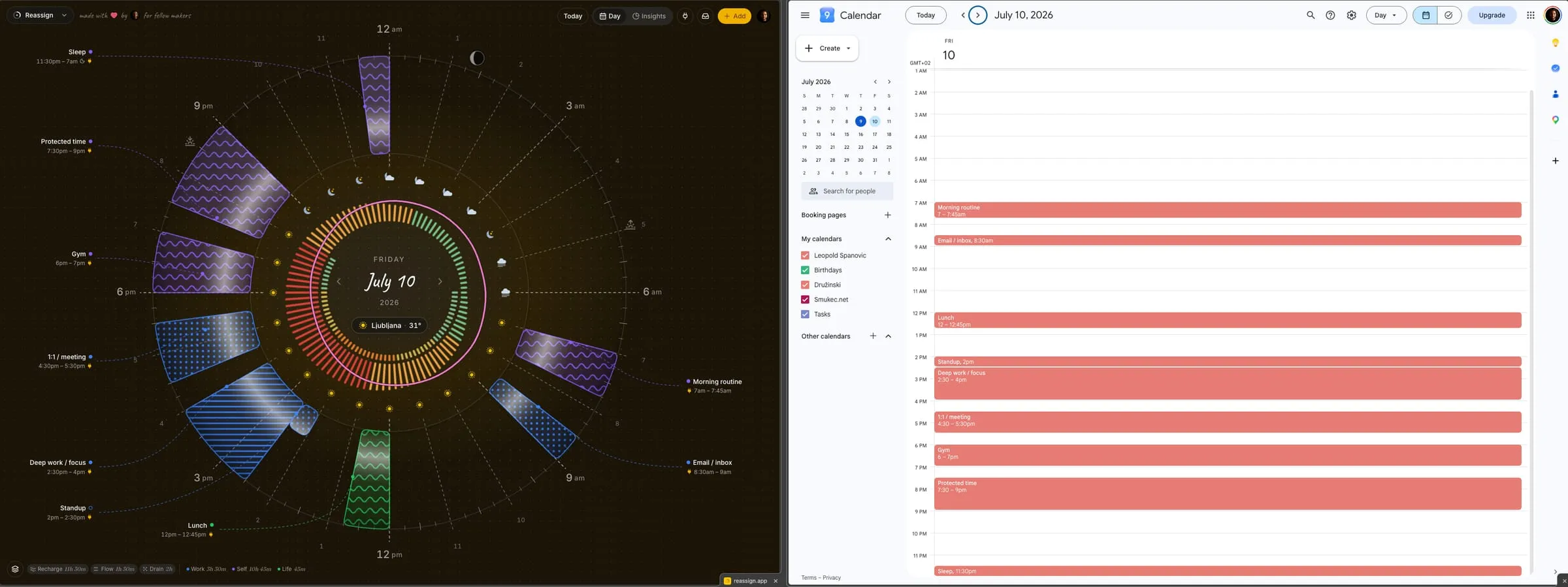
Time blindness is a sensing problem, and a list gives it a memory aid. Wrong prosthetic. What a time-blind brain needs is a rendering: time drawn as something the eyes can measure. We made the full argument in why a day is round; the short version is above, on the right. And if looking beats reading, open a day on the dial, free, and set it next to your list.
How to deal with time blindness: put time where your eyes are
Barkley’s prescription for time blindness is two words: externalize time. Stop trusting the internal clock. It isn’t there. Move time out of your head and into the room.
- Analog over digital. A digital clock is a number; you have to compute what it means. An analog face shows time as position and quantity: the slice between now and the meeting is literally visible. Some brains map time spatially without any help, a trait called spatial-sequence synesthesia. The rest of us can borrow the layout.
- Timers that show shape, not digits. The Time Timer, the red disk shrinking on classroom walls for decades, works because nothing needs decoding. Less red, less time. That single trick carries most visual timers.
- Alarms as landmarks, not nags. Not “reminder: meeting in 15.” Landmarks: one alarm to surface from the current task, one to physically stand up. The alarm’s job is to be the time sense you don’t have.
- Plan in blocks, sized honestly. Give every commitment a start, an end, and its real duration, the one from last time, not the optimistic one. Paper circular planners like the chronodex have done this on clock faces since 2011, precisely because shaded wedges make duration impossible to ignore.
- Buffer, because the estimates are still wrong. Externalizing time does not fix estimation. Pad transitions. Assume the shower was fifty minutes.
None of this is a cure, and anyone selling one is selling. These are prosthetics. A good prosthetic is still the difference between walking and not. If you want the tool version of this list, apps included, we compared the best apps for time blindness honestly, ours among them. And time perception is only half the problem: for the other half, task initiation, the strategy adults with ADHD report using most is body doubling, per 3,276 r/adhd comments about working from home.
A planner that keeps time visible
Everything above compresses into one design requirement: a time-blind brain needs a planner that renders time instead of listing it. A regular calendar’s day view gets halfway there, and credit where due: blocks drawn to scale beat rows, every time. But a column is a crop. You see 9 to 5 and scroll for the rest, while the edges of the day (the early hour you meant to claim, the evening that quietly absorbs every overrun) live off screen. A circle cannot crop. All 24 hours stay on one closed face, finite by construction. That requirement is why Reassign is round.
Your whole day sits on one 24-hour dial, midnight at the top, noon at the bottom. Every block is a wedge sized to its true duration, so the two-hour task is visibly eight times the fifteen-minute one, before you read a single label. The now indicator, a red hand on the ring, does what your internal clock won’t: past hours fade behind it, the remaining day stays bright ahead of it. You are here. The afternoon is this big. No feeling required, no arithmetic, just looking. It is the same mechanism that makes circular planning work so well for ADHD generally, aimed at time blindness specifically.
And for the days when time slips anyway, because it will, the plan bends instead of shattering: when one thing runs long, you slide it and everything after it down the dial in one move. The 4pm wall becomes a 4pm adjustment.
You cannot feel time. Fine. Build a day you can see instead.
Reassign is free to start. Pro adds two-way auto sync with Google Calendar, Outlook, and Todoist. The clock face is already drawn: start free.
Frequently asked
- What is time blindness?
- Time blindness is a persistent difficulty sensing time: feeling how much has passed, how much remains, and how long things really take. Hours vanish inside a task, five minutes of waiting stretches forever, and deadlines feel abstract until they are emergencies. The term was popularized by ADHD researcher Dr. Russell Barkley, who describes ADHD as a nearsightedness to time.
- Is time blindness a symptom of ADHD?
- Time blindness is strongly associated with ADHD, where studies consistently find differences in time estimation and time reproduction. It is not an official diagnosis in the DSM, and it is not exclusive to ADHD: people with autism, depression, or anxiety report it too, and everyone underestimates how long tasks take to some degree. In ADHD the effect is stronger, more persistent, and harder to compensate for.
- Is time blindness real?
- Yes, in the sense that matters: studies of ADHD consistently measure differences in time estimation and time reproduction, so the impairment is real and testable. What it is not is a standalone diagnosis. You will not find time blindness in the DSM; clinicians use the term as shorthand for a well-documented deficit, not as a formal label.
- What does time blindness feel like?
- Common experiences include losing hours to hyperfocus, chronic lateness or compulsive earliness, being unable to start anything before an appointment (often called waiting mode), and planning a day that needs 30 hours to actually happen. Time tends to collapse into two categories: now, and not now.
- How do you deal with time blindness?
- You cannot force yourself to feel time, so the working strategy is to externalize it: put time where your eyes are instead of trusting an internal clock. Analog clocks, visual timers that show time as a shrinking shape, alarms as landmarks rather than reminders, and planning blocks sized to real duration all help. None of it cures time blindness. It routes around it.
- What tools help with time blindness?
- Tools that show time as a quantity rather than a number: an analog clock, a visual timer like the Time Timer, and a planner that draws duration to scale. A 24-hour circular planner puts the whole day on one dial, sizes every block to its real length, and marks the current moment on the ring, so where you are in the day stays visible at a glance.
- How do I choose an app for time blindness?
- Choose the one that shows time as a quantity you can see, not a list you have to read. Look for three things: duration drawn to scale (a 2-hour block visibly twice a 1-hour block), a persistent marker of where you are in the day right now, and low enough friction that you keep using it. Visual timers cover a single task; a visual day planner covers the whole day. Reassign is built for exactly this: the full 24 hours on one dial, every block sized to its real length, and a now indicator moving around the ring. Free to start, so you can test whether seeing the day helps before paying anything.
- Is time blindness an excuse for being late?
- It is an explanation, not an excuse. The lateness is real and so is the impairment behind it. The useful move is not to argue about the label but to change the environment: external clocks, visible timers, alarm landmarks, and buffer time between commitments make lateness less likely without relying on a time sense that is not there.