Why students abandon study timetables by week five
Your study timetable is built for the ideal week, and a term has three kinds of week. Why study schedules fail, and how to plan one that survives a missed day.

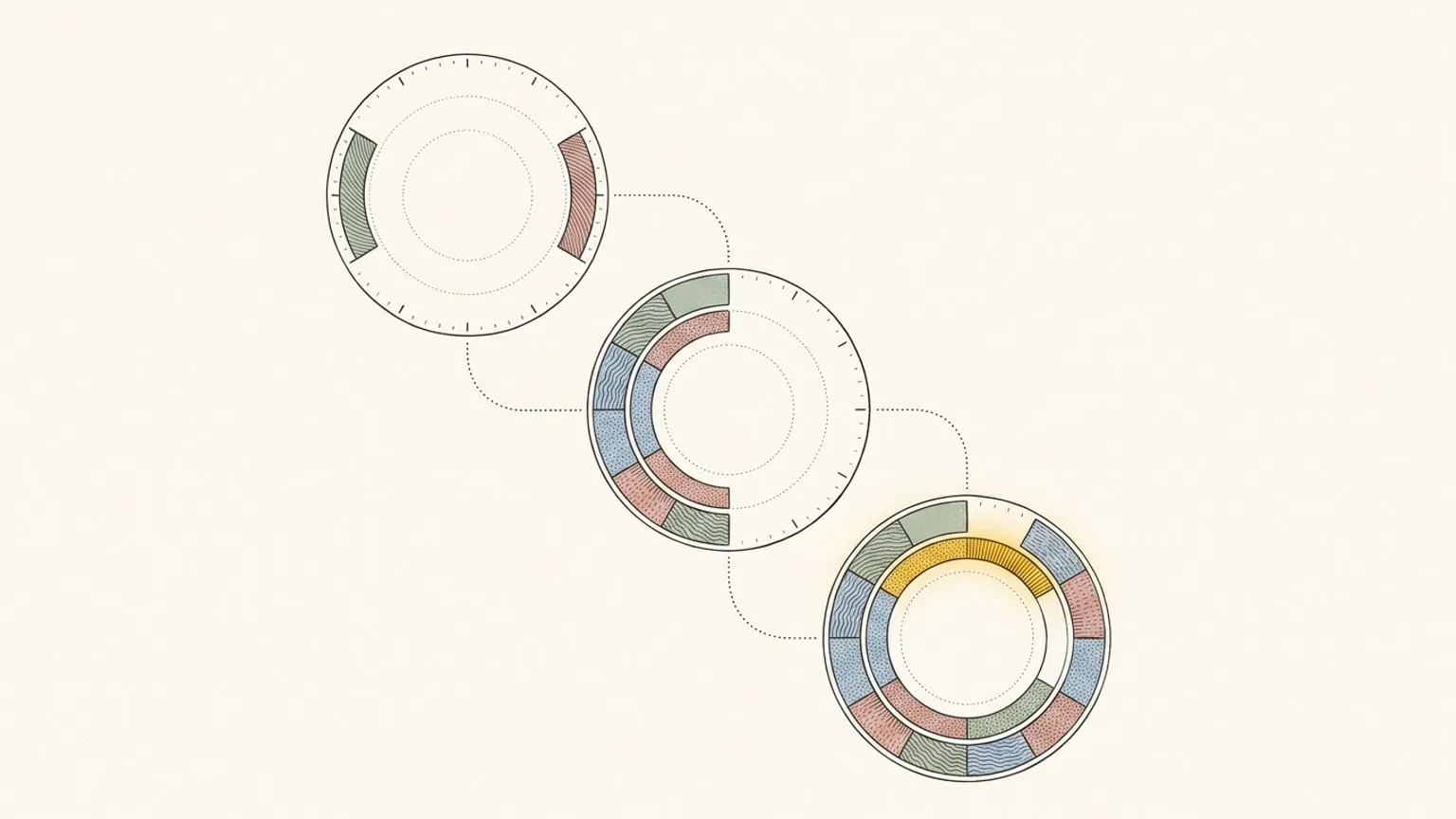
Most students abandon a study timetable because it was built for one ideal week, and a term is not made of ideal weeks. Deadlines bunch, exams replace lectures, and sleep drifts later, so by mid-term the grid describes a week you are not living.
You know the pattern. You make the timetable in week one. Every study block has a colour, every evening has a subject, and the grid repeats neatly to the end of term. By week five you are not using it. That is not a discipline problem. It is a design problem.
I make Reassign, a 24-hour circular day planner, so I have a bias toward planning tools that expect the day to change. Read what follows with that in mind. Most of it works on paper too.
If you want the general version of why planners die, the novelty and guilt mechanics are in why ADHD planners get abandoned. This post is about something narrower: why a study timetable fails, and what a term-shaped plan looks like instead.
Why does a study timetable work in week one and fail in week five?
Because week one is the only week it was designed for. You write the timetable when nothing is due yet, your sleep is still regular, and every free hour looks available. Then you copy that week across twelve.
A term has at least three kinds of week:
| Kind of week | What it looks like | What the timetable assumes |
|---|---|---|
| Normal week | Lectures, reading, a seminar prep or two | Correct, this is the week it was built for |
| Deadline week | An essay, a lab report, and a problem set, all due within days | The same two hours of “History” on Tuesday |
| Exam week | No lectures, long revision days, exams at fixed times | Lectures that no longer happen |
By the middle of term, the grid describes a week you are not living. You skip the Tuesday History slot because the lab report is due Thursday. That is the correct decision. But now the plan is wrong, and a plan that is wrong every time you open it soon becomes a plan you do not open.
Why do all my deadlines land in the same fortnight?
Because each module sets its own assessment dates, and nobody plans them together. When two or three modules pick the same weeks, the deadlines bunch. Your timetable spreads study evenly across the weeks. Your deadlines do not.
The estimates make it worse. In a classic study of the planning fallacy, Buehler, Griffin, and Ross asked 37 final-year psychology students when they would finish their honours thesis. The students also gave a pessimistic estimate: the date if “everything went as poorly as it possibly could.” The average pessimistic estimate was 48.6 days. The average actual time was 55.5 days. Fewer than half (48.7%) finished even by their worst-case date.
So even your “safe” estimate is probably short. When three of those estimates land in the same fortnight, a fixed weekly grid has no room to take the overflow.
The fix is to see the bunching before it arrives:
- Put every deadline and exam on one view in week one. One line per assessment, across the whole term. The bunches become obvious.
- Start the bunched work before the bunch. If three things are due in week seven, one of them starts in week four.
- Give each bunched deadline a dated first step. “Open the brief and list three questions” by Friday of week four. A deadline you can see is still not a task you can start.
Why does my sleep schedule drift during term?
Because student sleep tends to run late and irregular, and weekends push it later again. In a survey of 1,125 college students, Lund and colleagues classed over 60% as poor-quality sleepers, and bedtimes and rise times were later on weekends.
A timetable does not know this. It still has “Reading, 9:00” on Wednesday, while you went to bed at 2am after the lab report. That 9am block was planned for a person who slept at 11pm. The block fails, and it looks like your failure.
So plan study against the sleep you actually get:
- Put sleep on the plan first, as a block, the same as a lecture. Study blocks fit around it, not the other way round.
- Keep one anchor. A fixed wake time on weekdays does more than a perfect bedtime you never hit.
- Move hard work to when you think clearly. If your mornings are foggy in deadline weeks, the reading goes to the afternoon for those weeks. Energy-based planning covers how to find that window, and the ADHD sleep schedule guide covers the sleep side.
What does a plan that survives a missed day look like?
It expects the missed day. A timetable has a slot for every hour, so one missed session pushes the whole week out of shape. A term-shaped plan has three layers, and only the last one is detailed:
- The term, in outline. Every deadline and exam, on one page, made in week one. You do not change it often.
- The week, in blocks. On Sunday or Monday, look at the term outline and decide what this week is for. A normal week, a deadline week, or a revision week. Place the study blocks for that week only.
- The day, the evening before. Check tomorrow against how today went. Move what did not happen.
The week layer is where the plan survives. Leave at least one empty block per week that belongs to nothing. When you miss Tuesday, the Tuesday work goes into that block. Nothing else moves, and the plan is still true.
When a session runs long rather than getting missed, move the rest of the day with it instead of abandoning the afternoon. The guide to rescheduling your whole day shows how that works in one move.
What changes for students with ADHD?
The same three layers, with more of the work made visible. Time blindness makes a deadline in week seven feel far away until it is not, so the term outline needs to stay in view, not in a folder. A study block needs a size you can see: two hours of reading should look twice as long as one hour. And the dated first step matters more, because an unclear start is often where the block dies.
For help choosing a tool that fits, see how to choose an ADHD student planner.
Where Reassign fits
Reassign draws the day as one 24-hour dial. Lectures, study, shifts, and sleep sit on the same ring, each block sized to its length, so a night that ends at 2am visibly eats into the morning study block. When the day changes, you move the block. On Pro, on the desktop dial, you can also shift a block and everything after it in one move. There are no streaks or overdue counts: miss a day and the dial shows today.
It works in any browser, phone or desktop, as a web app you can install. An iPhone companion is being built. Pro costs $14/month or $120/year, and a new account gets 7 days of Pro with no card and no automatic charge. Pro includes two-way sync with Google Calendar, Outlook Calendar, Todoist, Google Tasks, Microsoft To Do, Linear, and TickTick, so classes already on a supported calendar can appear on the dial. Direct university ICS-feed subscriptions are not supported yet.
If you want to try the three layers without an app, the printable 24-hour planner is free, with no signup. Print one for tomorrow, put sleep on it first, and leave one block empty.
Frequently asked
- Why can't I stick to a study schedule?
- Usually because the schedule was built for one ideal week and then copied across the whole term. A term has at least three kinds of week: normal weeks, weeks where deadlines bunch together, and exam weeks. Your sleep also drifts across them. A timetable that assumes every week is week one stops matching your life by mid-term, and a plan that no longer matches your life is easy to stop opening.
- Why does my study timetable work in week one and fail later?
- Week one is the week the timetable was designed for: no deadlines yet, sleep still regular, energy high. By week five, essays and lab reports arrive in the same fortnight and the fixed weekly slots cannot absorb them. The timetable did not get worse. The term changed shape under it.
- What should I do after I miss a study session?
- Do not rebuild the week. Open today, look at what the missed session was for, and give it one new slot this week or drop it on purpose. A plan that survives a missed day is a plan with spare slots and one clear next action, not a plan that assumes you will never miss one.
- How far ahead should a student plan?
- Plan the term in outline and the week in detail. Put every deadline and exam on one view at the start of term, so you can see where they bunch. Then plan each week on Sunday or Monday against that outline, and plan each day the evening before. The detailed plan should never be more than about a week ahead of you.
- Is a study timetable a bad idea?
- No. A timetable is a good record of fixed commitments: lectures, labs, shifts. The problem is using the same weekly grid for study time as well. Keep the fixed things on a repeating grid, and plan study blocks week by week so they can move when deadlines bunch or exams arrive.