Put the hard work on the green.
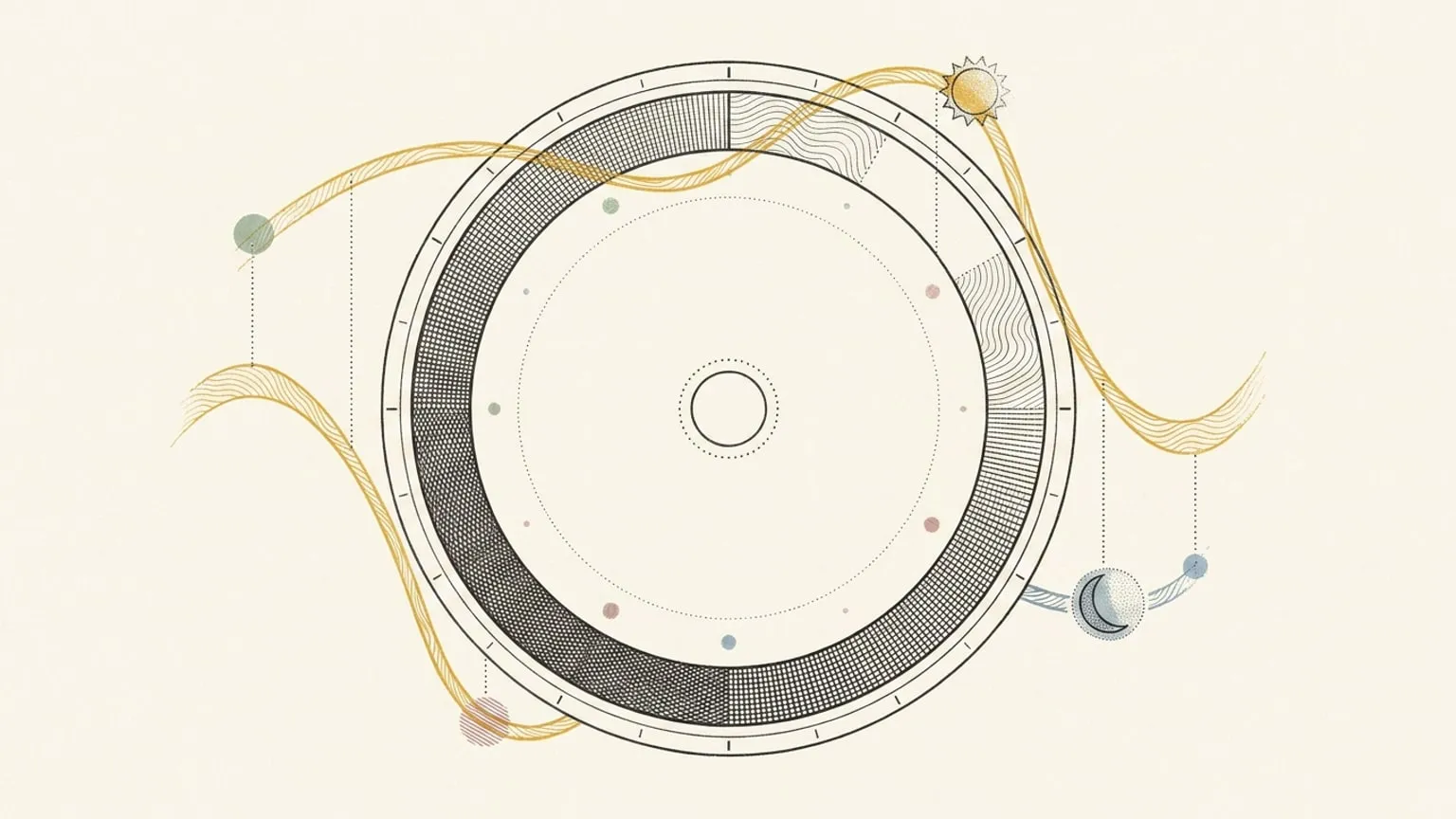
An empty hour is not the same as a good hour. The energy curve draws your body clock across the day, so you can put the work that needs your head where your head will actually be, instead of wherever the calendar happens to be free.
Included in Pro and the 7-day no-card trial.
One logged night starts it
Set your bedtime and sleep need once, with separate weekday and weekend schedules if you keep them, log a single night, and today’s curve draws. Green is where focus comes easy. Red is where you would only be fighting yourself. Want a preview first? The free circadian rhythm calculator draws the population curve for your sleep times, right in the browser: a prediction, not a measurement.
What you log bends the curve
A moment is not just a dot on the ring. A coffee lifts the curve fast and then dips it again a few hours later as it clears; anything you track that plausibly shifts alertness gets the same treatment. Tap a mark and the dial tells you in plain words why it moved the line.
Your cycle, if you opt in
The curve can carry one more rhythm. Switch on Cycle rhythm in the energy settings, log a period start (one tap a month), and the line bends with where you are in your cycle: a small, research-hedged late-cycle dip at first, reshaped by your own mood logs into your pattern rather than a template. It is off by default and asks for its own explicit consent. Cycle data lives in its own store and never reaches analytics, email, AI, or MCP, we never ask your gender, and one tap deletes all of it. What the evidence actually supports →
It reads back in Insights
Sleep debt, your rhythm over the weeks, and what recharges you against what drains you all sit in Time Insights, built from the same model. Opted in to Cycle rhythm? A cycle card reads your energy by cycle day, with a confidence band and your typical low window.
A prediction, not a measurement
This is a forecast of your alertness from your own sleep and what you have logged, not a reading taken off your body. There is no wearable to buy, no daily check-in to keep up, and no score. It is a prior that bends to you as you log more, and it can be wrong: it is there to argue with when you are choosing an hour, not to tell you how you feel.
This page is the what and the why. For the step by step, the docs cover the same ground as instructions: Energy curve in the docs →
Questions
- Do I need a wearable or a smartwatch?
- No. It is built from your bedtime, your sleep need, and one logged night. Nothing to buy and nothing to pair.
- How much do I have to log to keep it working?
- One night to start. It keeps drawing from your schedule after that, and the more you log the closer it gets calibrated to you.
- Is the energy curve free?
- The calibrated curve, weather, and mood are included in Pro. All planner features require trial or paid access. New accounts get a 7-day trial with no card required. A free population version, built from just your usual sleep times, runs in the browser at reassign.ai/circadian-rhythm-calculator. It is a prediction, not a measurement.
- Does the energy curve know about my menstrual cycle?
- Only if you opt in. Cycle rhythm is off by default and asks for its own explicit consent. Log a period start, one tap a month, and the curve bends with your cycle, calibrated by your own mood logs rather than a phase template. Cycle data stays out of analytics, email, AI, and MCP, and one tap deletes it.