Your cycle is not a template
Cycle syncing promises a productivity protocol for every phase. The evidence supports something smaller, and more personal. How Reassign bends its energy curve to your cycle: opt-in, hedged, and private by construction.

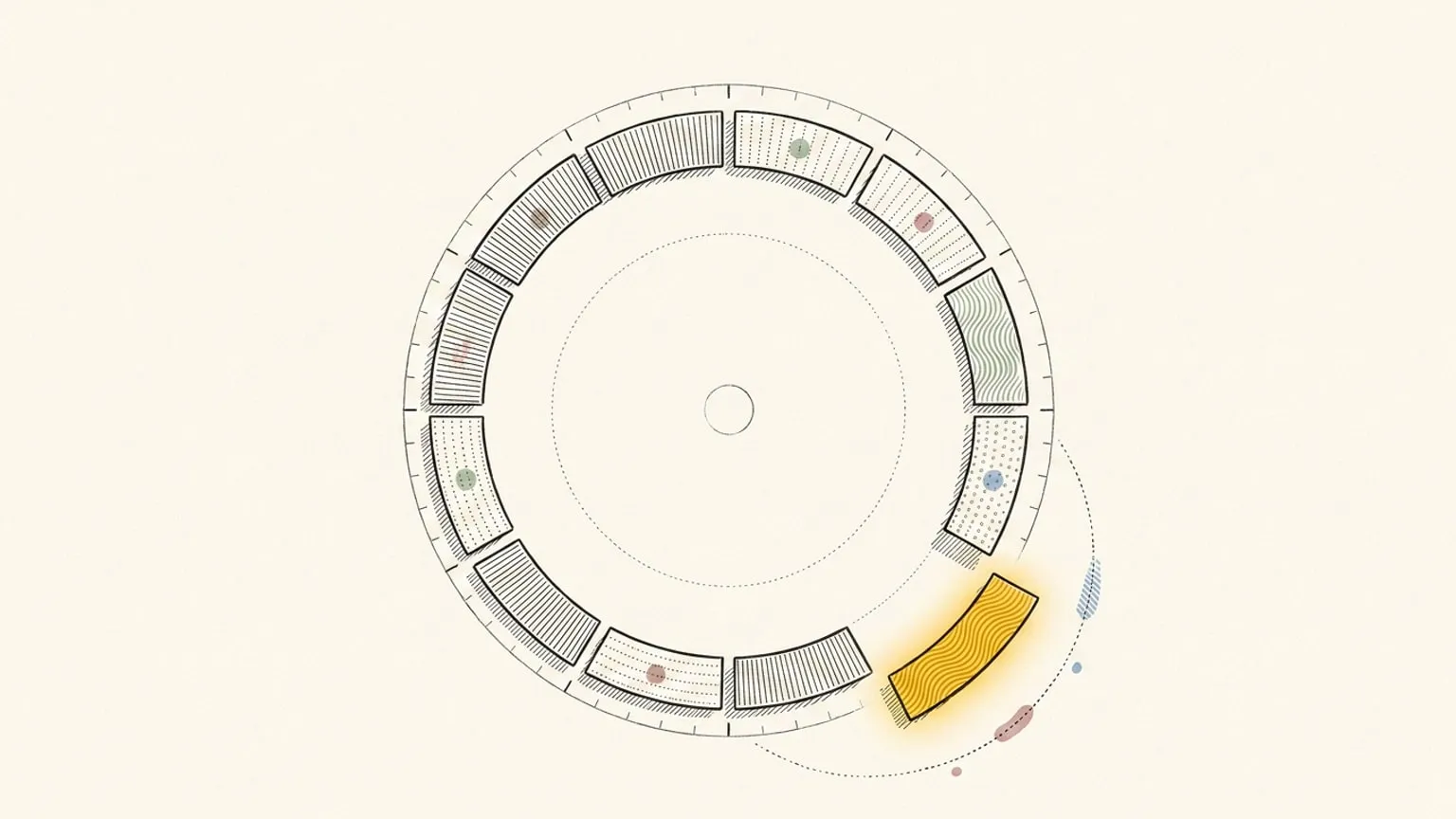
You have seen the chart. Four phases, four colour-coded weeks, each with its own to-do list: batch your creative work here, do your admin there, book the big presentation for the week the chart calls your inner summer. Cycle syncing is everywhere right now, and every version of it sells the same thing: a template.
The chart is tidy. The evidence is not.
What the evidence actually supports
Strip the protocols away and the research says something much smaller, and more useful.
The well-supported part: many people who menstruate feel a real dip in energy around menstruation itself. That shows up consistently, and if you have it, you did not need a study to tell you.
The rest is soft. In the one study that measured day-to-day energy against cycle day, the cycle explained under 4% of the variation. Sleep, stress, and plain daily noise explained far more. And the differences between people dwarf the average: PMS disrupts daily life for roughly one in five people who cycle, PMDD affects 3 to 8%, and plenty of people feel nothing at all.
Read those numbers again and the template collapses. A protocol built on the average cycle is a protocol built on a person who does not exist. For any given individual it is mostly noise, and following it means rescheduling your real life around someone else’s rhythm.
So why do the templates keep coming? Because the template is the product. An app that sells cycle syncing needs the phases to matter enormously and universally, or there is nothing to sell. Hedging does not demo well.
What an honest planner does instead
Reassign already draws an energy curve around the 24-hour dial: a per-hour line built from your sleep and bent by what you log, high where focus comes easy, low where you would be fighting yourself. The cycle is now one more rhythm that curve can carry. On its terms, not the chart’s:
It starts small and hedged. From your first logged period start, the curve carries a modest late-cycle dip: the one effect the research supports, at the size the research supports. No inner seasons, no four-phase work plan.
Your logs overwrite the prior. The curve calibrates against your own mood logs, the same way the rest of the energy model does. If your pattern is bigger than the average, the line learns that. If you turn out to be one of the people who feel nothing, the line learns that too, and flattens. The template bends toward you, never the other way around.
It costs one tap a month. Log a period start from the + Add menu, the command palette, or a right-click on the dial at the hour it happened. Missed one? Backdate it. The mark sits on the ring like any other moment, and you can drag it to re-time it.
It tells you why, in plain words. Tap the curve and the readout names the phase and what it is contributing, as a hedged suggestion rather than an instruction. In Time Insights, a cycle card reads your energy by cycle day, with a confidence band and your typical low window, once there is enough of your data to say so.
It is honest about irregularity. Calendar-based prediction degrades fast when cycles vary: for irregular cycles it can be off by close to a week. Reassign widens its ranges instead of faking precision, and the card says “typically” because that is what it means.
It knows when to stay quiet. One yes/no switch asks whether your periods come naturally. On hormonal birth control that suppresses the cycle, the model goes inert rather than inventing a rhythm. No method dropdown, no questionnaire.
How to actually schedule with it
The practical move is placement, not lifestyle redesign.
Keep the flexible, heavy work off your typical low window when you can. A deep-work block you control is cheap to move two days; a low day you pretended not to have is expensive. Protect a little more recharge in the window instead, and let the rest of the month be the rest of the month.
And keep the cycle term in proportion, because the model does. Last night’s sleep, the 3pm coffee, and the nap you did or did not take still move the curve more, most days, than cycle day does. The cycle is one voice on the line, not the conductor. That is not a limitation of the feature. That is the finding.
Private by construction
Cycle data is health data, and the record of this industry is bad in one specific way. The FTC’s cases against period and health apps (Flo, Premom, GoodRx) were not about databases being cracked. They were about the data leaking sideways into advertising and analytics pipelines. In one case, the violation was literally an analytics event named after the fertility log it was reporting.
So the guarantee that matters is not “stored securely”. It is “never leaves”. In Reassign:
- Cycle rhythm is off by default for everyone, and turning it on is a separate, explicit consent: use my cycle to shape my energy, my data stays private, I can delete it anytime.
- What is stored is minimal: the start dates you log, your typical length, one yes/no. We never ask your gender, and never infer it.
- The data lives in its own dedicated store, and it is excluded, by construction, from analytics and session replays, from every email (the dial in your morning brief renders with the cycle layer forced off), from AI processing, and from anything a connected assistant can read over MCP, even one you granted full access.
- Turning the feature off offers a one-tap delete of everything it stored. No email round-trip, no waiting.
The privacy policy names all of this, in those words, because a promise that is not written down is a vibe.
Turn it on, or don’t
Cycle rhythm lives in the energy layer’s settings, visible to everyone and off for everyone until you say otherwise. It is part of the energy curve, which is Pro, and the 7-day trial needs no card.
If the template version of cycle syncing has worked for you, keep it: a structure you trust is worth real money. But if the chart never quite matched your month, this is the other way. Log one tap when it starts, let your own days draw the line, and schedule against a rhythm that is actually yours.
Frequently asked
- What is cycle syncing?
- Cycle syncing is the idea of scheduling work, exercise, and social plans around the phases of the menstrual cycle: creative work in one phase, detail work in another. The idea is popular; the phase-by-phase protocols are far ahead of the evidence. What research supports more consistently is a dip in energy around menstruation, with large differences from person to person.
- Does the research support cycle syncing a work schedule?
- Mostly no, in the template form. In the one study that measured it, cycle day explained under 4% of day-to-day variation in energy, while differences between people were huge: PMS disrupts daily life for roughly one in five people who cycle, PMDD affects 3 to 8%, and many feel nothing at all. A dip around menstruation is reasonably supported. Detailed per-phase productivity protocols are not. Planning around your own logged pattern is the defensible version.
- How does Reassign track my cycle?
- One tap a month. You log a period start from the + Add menu, the command palette, or a right-click on the dial, and you can backdate one you missed. Reassign stores only the start dates you log, your typical cycle length, and one yes/no setting. From the first start it bends your energy curve with a small, hedged late-cycle dip, and your own mood logs reshape it into your pattern over time.
- Does it work with hormonal birth control?
- There is one yes/no switch: whether your periods come naturally. On hormonal birth control that suppresses the natural cycle, the model stays quiet instead of pretending a rhythm is there. No method dropdown, and the answer is stored as a single yes/no.
- Is my cycle data private?
- It is stored in its own dedicated store and excluded, by construction, from analytics and session replays, from every email, from AI processing, and from anything a connected assistant can read over MCP. Reassign never asks your gender. Turning the feature off offers a one-tap delete of everything it stored. The privacy policy names all of this explicitly.
- Is the cycle feature free?
- It is part of the energy layer, which is Pro, and it is off by default on every plan. Turning it on is a separate, explicit opt-in inside the energy settings. The 7-day Pro trial needs no card.