A decision needs somewhere to live
ADHD decision fatigue advice counts your choices. The real cost is re-deciding the same six all day. Why a schedule retires a decision and a list reopens it.

It is 11:40. Four things could plausibly be next. You rank them, and the ranking is not obvious, so you rank them again. Then you open Slack.
12:10. Same four things. Same ranking. Same nothing.
1:30, and now there are five, because one of the four grew a dependency while you were not looking. You run it again. You are tired in a way that does not match what you have done, which is, so far, nothing.
Here is what actually happened. You did not make three decisions. You made one decision, three times, and never got an answer out of it.
Do adults really make 35,000 decisions a day?
Almost every article about decision fatigue opens with the same statistic: adults make around 35,000 decisions a day.
I went looking for the study. There isn’t one.
The figure traces back to a 2015 faculty blog post by Joel Hoomans at Roberts Wesleyan University, and spread through a 2016 Wall Street Journal column written by an advertising creative director. It is frequently attributed to Sahakian and LaBuzetta’s Bad Moves (2013), and researchers who have gone looking through that book report the number is not in it. So it is a figure of speech that hardened into a statistic through repetition, which is a slightly embarrassing origin for the opening line of an article about how thinking is expensive.
I could hand you a replacement number here. I am not going to, because the best-known candidate comes from a researcher who later accumulated eighteen retractions and a university misconduct finding, and swapping one unreliable number for another would be worse than having none.
The honest position: nobody has counted. Counting would mean drawing a line around what a decision is, and nobody has drawn that line in a way that survives a real day.
It gets worse for the standard story. The mechanism underneath it, the idea that willpower is a finite pool that drains as you spend it, is one of psychology’s more public failures. A preregistered replication across 23 labs and 2,141 people found an effect of d = 0.04, with a confidence interval running from -0.07 to 0.15. That is a polite way of writing zero. The parole-judge study everyone quotes alongside it, where grant rates supposedly collapse before lunch, has been credibly attacked on the grounds that the cases were not ordered randomly in the first place. Its authors published a reply arguing the effect survives, so treat it as contested rather than settled, which is the opposite of how it is usually quoted.
And choice overload, the sibling claim that more options make you worse off, averages out to roughly nothing: 63 conditions drawn from 50 experiments and about 5,000 participants, mean effect near zero. It happens in some settings and reverses in others, which is what a real moderator story looks like, not a law.
Now the part that matters, and the reason this is not just debunking for its own sake.
Where the general-population evidence is weak, the ADHD-specific evidence is not. A meta-analysis of 59 studies of adults with ADHD, 12 of them on decision-making specifically, found decision-making deficits of similar magnitude to the attention deficits. Read that twice. The decision problem is about the same size as the attention problem, and only one of the two made it into the name of the condition.
So the pop-science version is shaky in exactly the place the ADHD version is solid. Which means the advice built on the pop-science version is aimed at the wrong variable.
What is ADHD decision fatigue, actually?
The cost is the re-decision, not the decision.
You are not making thousands of decisions. You are making about six, over and over.
What now. What next. How long will this actually take. Is this still the right one. What did I say I would do at two. Have I already decided this.
Six questions, running all day, each one charged at full price every time it comes round. Nothing recorded the answer, so nothing closed the question.
A decision needs somewhere to live or it expires. Decide at 9am that the afternoon is for the proposal, keep that only in your head, and by 1pm it is gone. Not forgotten exactly. Just no longer load-bearing. It has decayed from a thing I decided into a thing I was thinking about earlier, and those two have completely different authority over your afternoon.
Two things make this sharper with ADHD.
The first is that you re-derive rather than recall. If holding the decision costs more than remaking it, your brain quietly takes the second option, every time, without telling you it made a trade.
The second is that the answer moves. You are not re-running the same calculation and getting the same result. At 11:40 the proposal is obviously the priority. At 1:30 the thing with a person attached to it has climbed, because urgency is loud and importance is quiet. Same inputs, different output. Which is why repetition never makes the decision cheap: you are not practising, you are relitigating.
That is also the cleanest line between two failures that get merged constantly. If several things could be next and you cannot pick, that is a selection problem. If you know exactly which task it is and still cannot begin, that is an activation problem, and it needs a different fix entirely. Shrinking your options does nothing for the second. Breaking the task down does nothing for the first.
Why is a to-do list worse than a schedule?
A list stores options. It does not store answers.
Which means every time you open it, you run a fresh ranking pass over everything on it. Twelve items, and you are not reading twelve items, you are performing a twelve-way comparison, again, with slightly different weights than last time.
The cruelty of this is that the more complete your list, the more expensive each glance gets. You did the responsible thing. You captured everything. Now every look costs more than it did when the list was scrappy and half-wrong.
This is the part that catches people who have done the work. Getting the pile out of your head is genuinely correct advice. It stops the 3am inventory. But if the dump ends its life as a list, you have not externalised the decision. You have externalised the information and left the decision exactly where it was, except now it has better raw material and comes round more often.
A list you look at forty times is not a record of your thinking. It is a machine for reissuing the same question.
There are other reasons a list works badly for an ADHD day, and they are worth reading separately. This one is specific: a list cannot close a question, so every question it holds stays open.
A schedule is a decision archive
Here is the flip.
A block is a decision with a timestamp on it.
Not “the proposal is on the list.” Instead: “the proposal, 9 to 10:40, decided last night by someone who had the capacity to weigh it.” The value is not that it reminds you. The value is that the question is closed. At 9am you are not choosing. You are reading what you already chose.
Last-night-you is not wiser than this-morning-you. Last-night-you simply had the enormous advantage of deciding once, for the whole day, with nothing on fire. That is the entire trick. Decide once, at the cheapest hour, and let the artefact carry it.
This is also where the strongest evidence in the whole field sits, and it is not the evidence anyone cites. If-then planning, specifying the when and where and how in advance rather than shrinking your options, comes in at d = 0.65 across 94 independent tests. A 2025 meta-analysis put 642 tests through the same question and found effects between 0.27 and 0.66. And it works in ADHD specifically: children with ADHD given if-then plans reached the same level of response inhibition on a go/no-go task as children without ADHD.
Note what the intervention is not. It is not choosing between fewer options. The goal is already picked. The intervention is fixing the hour.
The strongest form of this is the decision you retire permanently instead of daily. If you make the same call every Tuesday, make it recur, and it stops asking. A routine is a decision you only have to make once.
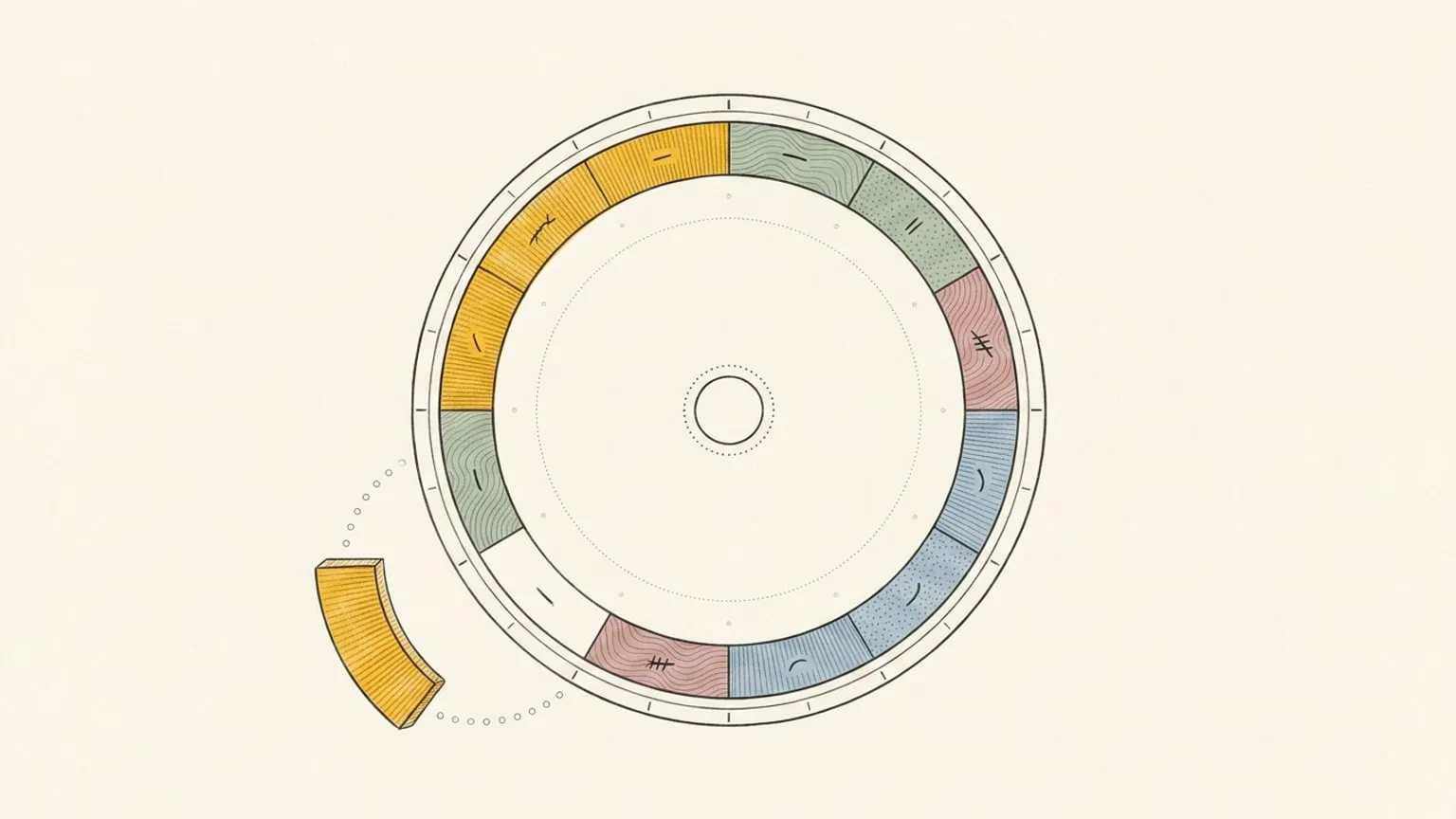
This is the argument for a day drawn as a ring rather than a column. All 24 hours are one object, nothing scrolls out of view, so the answer sits where your eyes already go instead of in a second surface you have to remember to open. The evening is not abstract while you are inside the morning. You are not deriving the shape of your day, you are looking at it.
Five strategies that all happen before
The standard advice for ADHD decision fatigue, which you will find in some order on nearly every page about it, comes down to five moves: decide ahead of time, shrink your menu of options, build low-demand transition routines, externalise your decisions, and lower the threshold to start.
Credit where it is due, because two of these are better than their reputation.
Shrink the menu is underrated and rarely stated this plainly. Three breakfasts on rotation is a real instruction with a real effect, and it is the one people skip past on the way to something that sounds more sophisticated.
Decide ahead of time is implementation intentions with the label filed off, and as we just saw, it has stronger evidence behind it than almost anything else in this category. It is usually presented as a nice habit. It is the best-evidenced finding on the page.
Low-demand transition routines are concrete and specific: water, curtains, stretch, look at the day, keep the phone out of it until you have done the rest. Prompted routines are the home ground of apps built around them, and that is a fair thing for them to be good at.
Two of the five need correcting.
Lower the threshold to start is good advice about a different problem. Open the document, put away five dishes. That is task initiation, and it belongs in not being able to begin or breaking a task into its first physical step. It has been folded in here because both failures feel like being stuck, and feeling the same is not being the same.
Externalise your decisions is the softest, and it is usually the opposite of what it says. “Move your plans into a visible system” and “use a task tool to capture everything with time estimates” both externalise information. Neither externalises a decision. See the previous section: that is how you end up with a well-maintained decision generator.
Now the thing that connects all five.
Every one of them happens before. Every single one is executed in advance, by a version of you who is calm, has capacity, and is not currently inside a day that is coming apart. Which is fine, and none of them survive 2pm.
The decision you cannot make in advance
2pm. One thing ran ninety minutes long.
Everything after it is now back in play. Not one decision, all of them, simultaneously, and the meeting you were going to move has a person attached, and the thing you had protected for the proposal is now the only flexible object in the day so it is about to get eaten again.
This is the peak decision load of your entire day, and it arrives at the hour you have least left. It is also the moment when almost nothing in the standard advice applies, because the standard advice was all front-loaded by definition.
There is no clean way to prepare for this. What you can change is what it costs when it arrives.
The move is to shift rather than re-plan. Move the block that ran long, let everything after it travel with it, hold whatever is genuinely anchored to a time, and look at the result before you commit to it. That is one decision about a slipped hour rather than eleven decisions about eleven blocks. In Reassign the whole run moves together on the desktop dial, nothing is committed until you say so, and undo is there if the answer was wrong. Reversible decisions are cheaper decisions, which is a boring point that almost nobody makes.
If you would rather say it than drag it, Pro adds two ways to. Ask AI takes “push everything after lunch back an hour” as one sentence and lands it as cards you approve, on submit, never fired automatically. Say the same sentence to the dial by voice and a move like this applies at once, with one Undo in a toast. A delete or a clear still comes back as cards. Over MCP, Claude reads the real day and edits it with the same operations you would use by hand, and every change shows up on the dial to keep or undo.
The rail, in the same breath rather than in a footnote: it proposes, you approve or undo, and it does not decide what your day is for. A tool that made the judgement calls for you would not be removing the decision, it would be removing the part of the day you are actually there for.
One more thing about timing, since almost every piece on this topic ends with “make your hard decisions in the morning while you are fresh.” That advice descends from the depletion model, which we have already established is wobbling, and from studies of physicians and judges working conventional hours. ADHD is strongly associated with a delayed body clock, which means the alert window other people get mid-morning can land for you hours later. The rule that survives is not decide early. It is decide at your peak, which requires knowing where yours actually is.
What a planner can honestly take off you
Less than the marketing in this category claims. More than nothing.
What it can do:
- Hold the answer. A block records what you decided and when it happens, so the question is closed rather than represented. Included in Pro.
- Show the whole day at once. One ring, 24 hours, nothing scrolling out of view, so you are reading the shape rather than deriving it. Included in Pro.
- Retire the repeats. Recurring blocks mean a decision you make weekly gets made once. Pro.
- Move a slipped day in one gesture. Shift a block and the run comes with it, previewed before it commits, undoable after. Included in Pro, on desktop.
- Keep the undecided off today. Things you genuinely cannot place yet go to the Inbox instead of sitting on today’s ring re-asking. Pro.
- Turn a pile into a plan. Braindump resolves a dump into an editable plan rather than a list. It cannot delete or clear anything, by design. Pro.
What it cannot do, stated at the same length, because the list of limits is the useful part:
- No icon-prompted routines. There are opt-in push alerts when a block or a break starts, and opt-in email digests, including an evening nudge when tomorrow is still empty, and that is the whole of it. If prompted routines are the half you need, Tiimo is genuinely good at it and this is not an argument against using it.
- No measurement of your decision load. Nothing measures that. Any product claiming a number for it is modelling, not measuring.
- No native app, watch face, or widgets. It is a web app you can install, with internet required to save changes.
- It cannot decide what matters to you.
- It cannot stop you reopening a question you already answered. The tool can hold the answer. It cannot hold your attention.
And a refusal worth naming, since this is a topic that invites the opposite: there is no decision score, no streak, no counter that turns red when you re-decide something. A tool that graded your decision-making would be one more thing to be behind on, and being behind on things is not the gap in your life.
Fewer decisions is not the same as more room
There is a move at the end of most articles like this that I want to keep, because it is the right ending and it would be cheap to sneer at it.
Eating the same safe dinner you already know you like is not a failure of imagination. Same breakfast, same order, same route, same three shirts. Those are all legitimate, and the reason they work is not that you are simplifying your life aesthetically. It is that each one is a question that stopped being asked.
The trap is what comes next. You retire four decisions and immediately spend the space on a more ambitious plan, which generates six new ones, and you are back where you started while feeling briefly like you were winning.
A day with fewer open questions in it is also a day you are allowed to leave alone. That is the part the category quietly discourages, because nobody sells anything on the back of it.
What to try this week
One experiment, tonight, ten minutes.
Write down the four questions you know you will otherwise reopen all day tomorrow. Not your tasks. The questions: what to do at 9, what happens to the afternoon, which of the two competing things wins, what you are doing about the thing you have been not-doing for a week.
Answer them onto hours. Not onto a list. Onto specific hours of a specific day.
Then tomorrow, when you catch yourself opening the list at 11:40, notice what you are actually doing. You are not deciding. You are checking whether you agree with someone who already decided, had more capacity than you have right now, and was you.
And pick the one decision you make every single week. Make it recur, so it stops asking.
Reassign is a 24-hour circular day planner. 7-day Pro trial, no card required. Answer tomorrow once, tonight.
Sources. The ego-depletion replication is Hagger et al. (2016), Perspectives on Psychological Science 11(4): 23 labs, N = 2,141, d = 0.04, 95% CI [-0.07, 0.15]. Choice overload is Scheibehenne, Greifeneder and Todd (2010), Journal of Consumer Research 37(3): 63 conditions drawn from 50 experiments, N ≈ 5,000, mean effect near zero with substantial heterogeneity. ADHD decision-making is Mowinckel, Pedersen, Eilertsen and Biele (2015), Journal of Attention Disorders 19(5): 59 studies, of which 12 measured decision-making. Implementation intentions are Gollwitzer and Sheeran (2006), Advances in Experimental Social Psychology 38: 94 independent tests, d = 0.65; and Sheeran, Listrom and Gollwitzer (2025), European Review of Social Psychology 36(1): 162-194, 642 tests, effects from 0.27 to 0.66. The ADHD go/no-go result is Gawrilow and Gollwitzer (2008), Cognitive Therapy and Research 32: 261-280. The parole-judge study is Danziger, Levav and Avnaim-Pesso (2011), PNAS 108(17), and the case-ordering critique is Weinshall-Margel and Shapard (2011), PNAS 108(42): E833, to which the original authors published a reply maintaining the effect holds. The prevalence figures quoted in the FAQ come from Oroian, Nechita and Szalontay (2025), European Psychiatry 68(S1), which is a congress abstract with 50 participants rather than a full peer-reviewed paper. Descriptions of the standard five-strategy advice were checked against published ADHD resources on 3 August 2026.
Frequently asked
- What is ADHD decision fatigue?
- It is the experience of small choices costing far more than they should, and of that cost climbing through the day until you stop choosing at all. The usual explanation is that decisions drain a finite pool. That mechanism is on shaky ground: the ego-depletion effect it rests on produced d = 0.04 across 23 labs and 2,141 people in a preregistered replication. A better account of what actually happens with ADHD is that you are not making thousands of separate decisions, you are re-making a handful of them. A decision you took at 9am and stored only in your head has expired by 1pm, so you derive it again from the same inputs at a worse hour. The exhaustion is real. It is repetition, not depletion.
- Do adults really make 35,000 decisions a day?
- There is no research behind that number. It traces to a 2015 faculty blog post by Joel Hoomans at Roberts Wesleyan University and spread through a 2016 Wall Street Journal column written by an advertising creative director. It is often attributed to Sahakian and LaBuzetta's book Bad Moves (2013), where people who have gone looking report it does not appear. Nobody has counted your daily decisions, because counting them would mean drawing a line around what a decision is, and no one has done that in a way that survives contact with a real day. Treat 35,000 as a figure of speech that hardened into a statistic.
- Is decision paralysis a symptom of ADHD?
- It is not a diagnostic criterion, and no clinician will diagnose you on it. But the underlying difficulty is well measured. A meta-analysis of 59 studies of adults with ADHD, 12 of them on decision-making specifically, found decision-making deficits of similar magnitude to attention deficits. That is worth sitting with: the decision problem is about as large as the attention problem, and only one of the two is in the name of the condition.
- Do people with ADHD get decision fatigue faster?
- The honest answer is that nobody has run the clean version of that experiment. What is measured is that decision-making itself is harder: the same meta-analysis of adults with ADHD found deficits on decision-making tasks comparable in size to attention deficits. A small 2025 European Psychiatry congress abstract of 50 adults with ADHD reported 82% with frequent decision-making difficulty and 35% experiencing decision paralysis daily, though that is a conference abstract with 50 participants rather than a full paper, so hold it loosely. What follows is that each decision costs more, not that some hidden tank empties sooner.
- Why do I keep re-deciding the same thing?
- Because the first decision had nowhere to live. If you decide at 9am that the afternoon is for the proposal and hold that only in working memory, the decision does not survive to 1pm as a settled thing. At 1pm you look at the same list, run the same ranking, and reach a slightly different answer, because what feels urgent has moved. Nothing recorded that the question was already closed, so it reopens. This is why repetition never makes the decision cheaper: you are not practising one decision, you are paying full price for it several times.
- What is the difference between decision fatigue and ADHD paralysis?
- They are different failures and they need different fixes. Decision paralysis is a selection failure: several things could plausibly be next and you cannot pick one. Task paralysis, or the initiation problem, is an activation failure: you already know which task it is, it is not ambiguous, and you still cannot start. Shrinking your options helps the first and does nothing for the second. Breaking the task into a first physical step helps the second and does nothing for the first. Most advice merges them, which is why it half-works.
- Why is a to-do list worse than a schedule for decision fatigue?
- A list stores options. A schedule stores answers. Every time you open a list you run a fresh ranking pass over everything on it, and the more complete the list, the more expensive each glance becomes. The artefact you built to hold your thinking turns into a machine for reissuing the same question. A block on a schedule is a decision with a timestamp attached, so the question is closed rather than represented. That is also why getting everything out of your head is good advice that can still make the day worse, if what you end up with is a list.
- How do I reduce decision fatigue with ADHD?
- Decide fewer things more permanently, and decide them at the hour that costs least. The best-evidenced move is an if-then plan that fixes the when and where in advance rather than shrinking your options: 94 tests put that at d = 0.65, and a 2025 meta-analysis of 642 tests found effects from 0.27 to 0.66. It works in ADHD specifically, where children given if-then plans reached the same response-inhibition level as children without ADHD. Practically: put the decision on an hour instead of a list, make the ones that repeat actually recur so they stop asking, and send anything you genuinely cannot decide yet to your Inbox rather than letting it re-ask all day.
- Should I make my hard decisions first thing in the morning?
- Not automatically. That advice descends from the depletion model and from studies of physicians and judges working conventional hours, where decision quality drops later in a session. Your own peak depends on your body clock, and ADHD is strongly associated with a delayed one, so the alert hours other people get mid-morning can land for you much later. The rule that survives is decide at your peak, not decide early. Which means the useful thing to know is where your peak actually is.
- What do I do when my whole afternoon falls apart?
- Recognise that this is the expensive moment, because every remaining commitment goes back into play at once, at the hour you have least left. The move is to shift rather than re-plan: move the block that ran long and let everything after it come along, keeping whatever is genuinely anchored, then look at the result before committing to it. Re-deciding the afternoon from scratch is what makes a slipped hour cost a whole day. The advice you usually find does not cover this, because almost all of it is executed in advance by someone who is not currently inside a broken day.
- Can a planner app actually reduce decision fatigue?
- Within limits, and no app measures your decision load, ours included. What a planner can do is hold the answer so the question stops reopening: a block records what you decided and when it happens, so at 11:40 you are reading a decision rather than making one again. Reassign draws the whole 24 hours as one ring so nothing scrolls out of view, and lets you shift a run of blocks in one move when the day slips, which is included in Pro on the desktop dial. Making a recurring decision actually recur is part of Pro. What it cannot do is decide what your day is for, or stop you reopening a question you already answered.