Your energy has a shape, not just a size
Spoon theory tells you how much energy you have, never when. How the circadian curve and sleep pressure set your ADHD peak hours, and how to find yours.

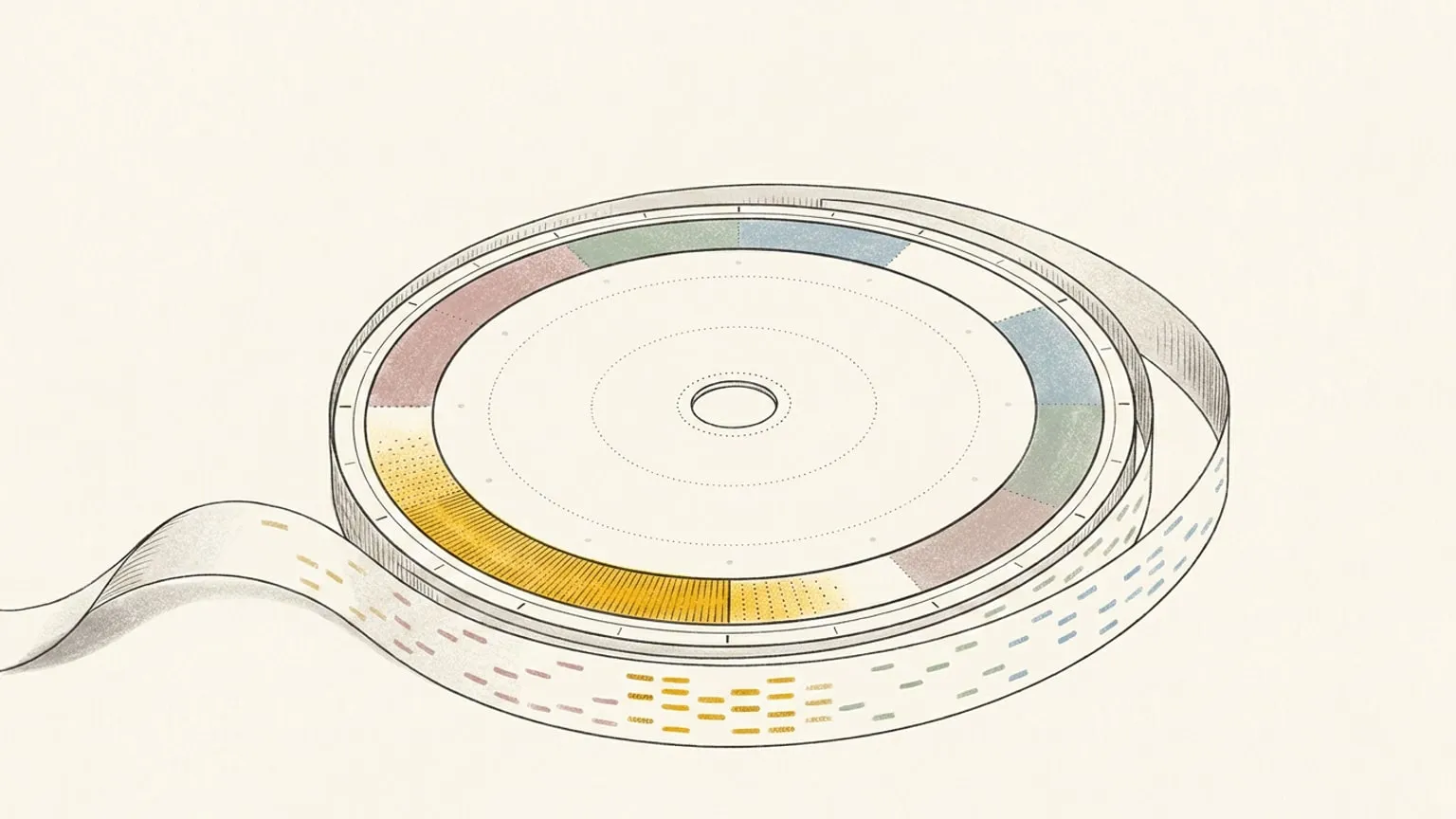
Spoon theory hands you a number. Twelve spoons, say, and a list of things that each cost one or two, and the discipline to stop before you hit zero.
It is a good model. It gave a lot of people the first language they had for a limit nobody else could see. But it has never once told you which hours the spoons are in.
That gap is where most energy advice quietly ends. You learn how much you have and how not to spend it all by Tuesday, and then you sit down at 3pm to do the hardest thing on the list, because 3pm was free, and you burn four spoons on something that would have cost one at half past ten.
Free and capable are different questions. A calendar can only answer the first.
There is a second cost hiding in that 3pm, which is that you probably answered this same question at 9am and again at noon. Deciding when is its own expense, and it is charged every time the answer fails to stick.
Why “how much energy” is only half the question
There are two separate literatures about energy, and almost nothing that reads both.
The first is about quantity. Spoon theory, energy accounting, the brain-battery metaphor, boom-and-bust cycles. It is written for and often by neurodivergent people, it is genuinely good on pacing and on explaining yourself to other people, and it contains essentially no information about time of day.
The second is about timing. Circadian rhythm, chronotype, sleep pressure, peak hours. It is written by sleep scientists and repackaged by productivity apps, it is precise about when, and it almost never mentions ADHD. It also, in nearly every consumer form, wants you to buy a wearable first.
So the question a lot of people are actually asking falls straight down the middle: I know I have limited energy. When is it?
What actually sets your energy through the day
Two things, pulling against each other. Sleep scientists have modelled it this way since the early eighties, and the framework has held up well enough that it is still the standard account.
Process C: the clock that lifts you
Your circadian rhythm is a roughly 24-hour cycle that raises and lowers alertness whether or not you slept well, whether or not you are interested in the task. It is a body clock, not a mood.
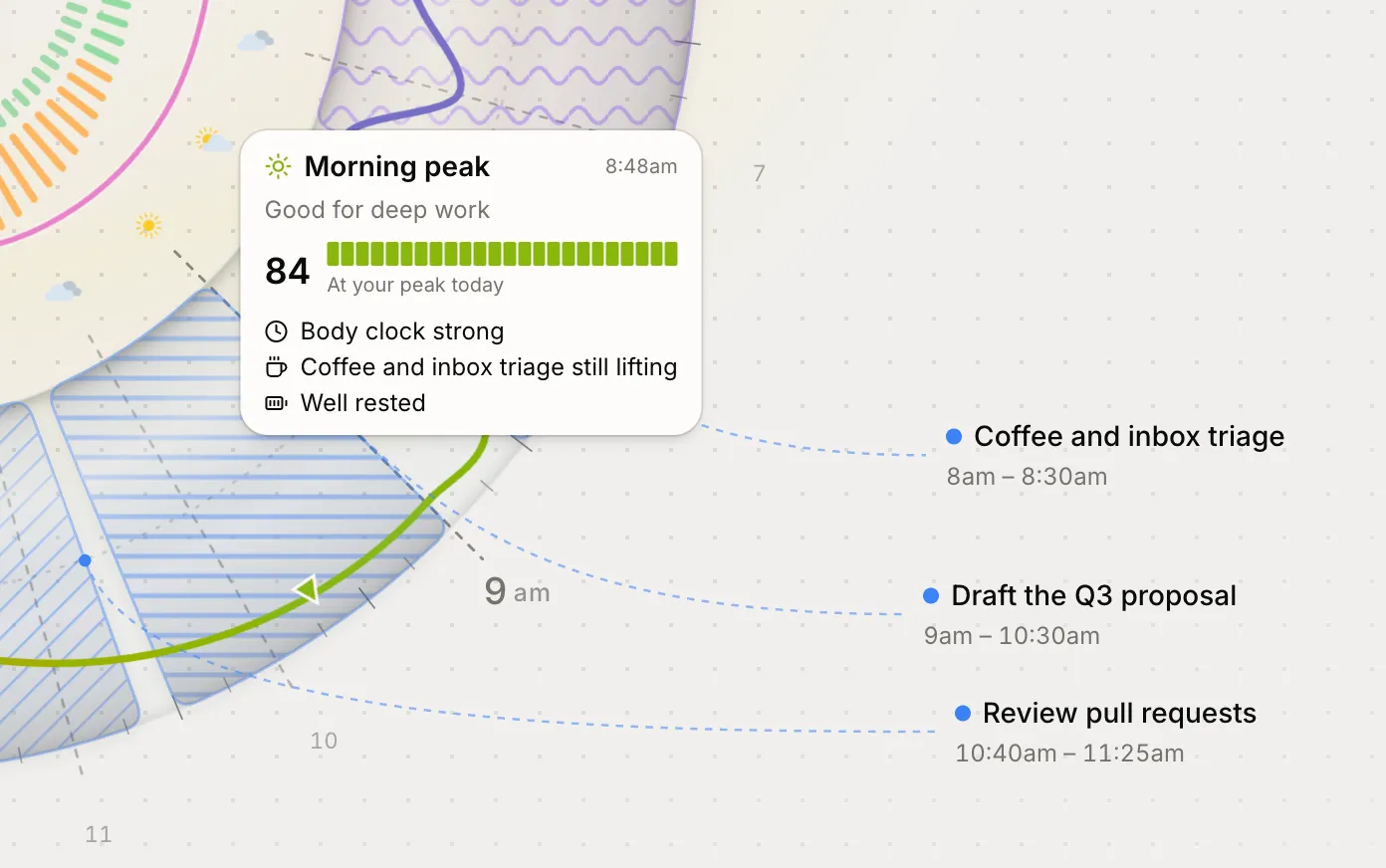
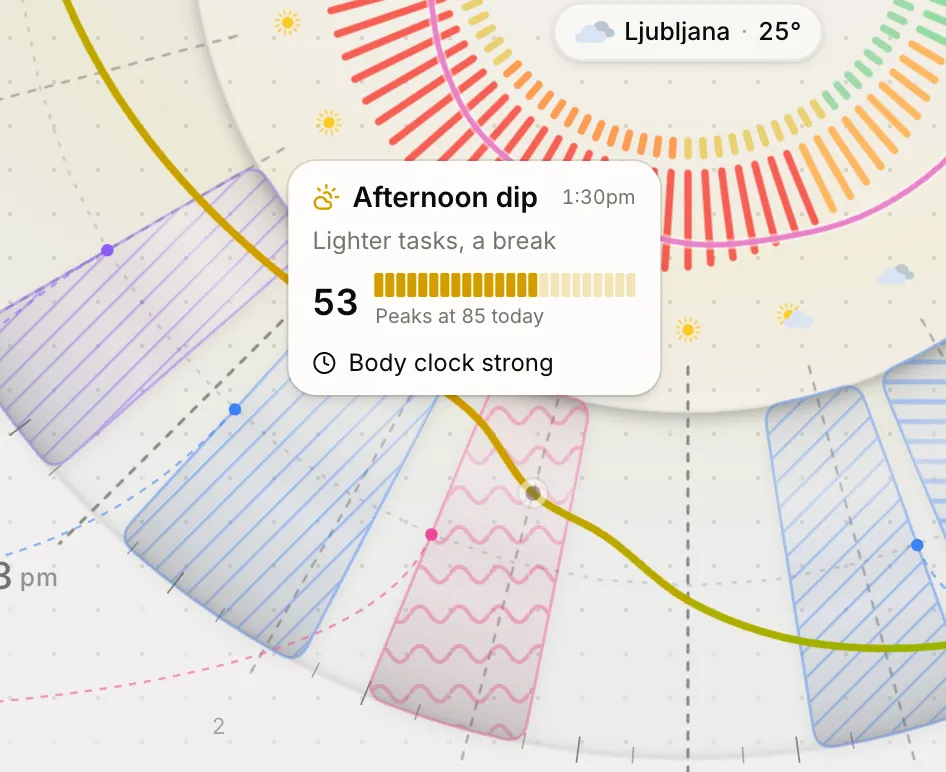
The useful detail, and the one most productivity writing gets wrong: it is not a single hump. Alertness is biphasic. There is a morning peak, a genuine dip in the early afternoon, and a second lift in the early evening before the long fall into night. That afternoon slump is not your lunch and it is not a discipline failure. It is the shape of the curve.
Where exactly the morning peak falls is more movable than the averages suggest. Sleep pressure is near zero when you wake and climbs from there, so the high point of the combined curve tends to arrive earlier than the body clock alone would put it, and anything you drink pulls it earlier still.
Process P: the pressure that builds while you are awake
From the moment you wake, sleep pressure starts accumulating. The longer you are up, the heavier it gets. Sleeping discharges it, and a full night discharges most of it.
This is the part that carries between days, and it is why one bad night is not one bad day. Pressure that did not clear on Tuesday night is still sitting on Wednesday’s curve, dragging the whole line down.
Why that makes a curve, not a battery level
Take the circadian lift, subtract the weight of sleep pressure, and you get a continuous line across the day.
Which is why the fuel-tank metaphor misleads, however useful it is for pacing. A tank drains in one direction. A curve comes back. Your energy at 7pm can be genuinely higher than at 3pm despite the extra four hours of use, because the clock lifted more than the pressure grew. Any model that only counts what you have spent cannot explain the second wind, and the second wind is real.
Why the ADHD curve is not the average curve
Here is where the generic advice breaks. Almost every article about peak hours quotes an average: your peak is late morning, deep work belongs at 10am, and so on. For a large share of ADHD readers that is not slightly off. It is the wrong hours.
The clock runs late
ADHD is consistently associated with a delayed circadian phase and evening chronotype, and the effect is not marginal.
The mechanism is the hormone that starts your night. Melatonin is the signal that tells the body it is evening, and in a delayed phase it arrives late, so the instruction to wind down lands hours after the world expected you to be winding down. That is also why the delay can be measured rather than merely reported: you can time the melatonin rise directly, and the highest estimates below are the ones built that way.
The numbers depend heavily on how you measure. Bijlenga and colleagues put a sleep questionnaire to 202 adults with ADHD and 189 controls, and found an indication of delayed sleep phase in 26% of the ADHD group against 2% of the controls. That is self-report, and it is the conservative end. When Van Veen and colleagues measured it directly by salivary melatonin rather than asking, the figure was closer to 78%, though on a much smaller sample of 40 adults. A clinical study of 102 adults with ADHD classified about a third as having delayed sleep phase disorder.
Take the lowest of those and it is still thirteen times the rate in the same study’s control group.
The spread between 26% and 78% is itself the interesting fact. The more directly you measure the body clock, rather than asking people to report on it, the more delayed the ADHD population looks.
A perspective article has gone further and argued that a subgroup of ADHD is best understood as a circadian rhythm disorder, with chronotherapy as a treatment implication. Worth reading, and worth reading carefully: the defensible claim is a strong association in a subgroup, not that ADHD simply is a circadian disorder. Its practical advice is about moving a late clock rather than planning around it, and the sleep schedule post goes through what each step was tested on.
What this means at the level of a Tuesday: if your clock runs two or three hours late, your late-morning peak is an early-afternoon peak, your afternoon dip lands at five, and your evening second wind arrives at eleven at night, which is exactly when everyone congratulates themselves on your sudden focus and you wonder why you cannot do this in daylight.
Medication timing is not circadian
One honest complication. If you take stimulant medication, some of what you experience as an energy curve is a dose curve, and the two run on different clocks. A crash that lands at the same time every day regardless of how you slept is behaving like a medication effect, not a body-clock one.
That distinction is real, it matters for planning, and it is where this article stops. Dose timing is a conversation with your prescriber. No planner should have an opinion about it.
Boom and bust is a spending problem, not a timing one
The quantity literature is right about one thing the timing literature ignores completely: on a good day it is entirely possible to spend six hours of energy you did not have, and pay for it for three days.
Timing does not fix that. Knowing your peak makes it easier to do hard things, which makes it easier to overspend. If the pattern you recognise is a brilliant Monday followed by a written-off Thursday, the curve is not your main problem, and the reasons planners get abandoned are worth more of your attention than your peak hours are.
How do I find my peak hours without a wearable?
You need one number: the middle of your sleep.
Not your bedtime, not your alarm. The midpoint between actually falling asleep and actually waking. Chronotype research has used mid-sleep as its standard marker for decades, and your alert hours sit a fairly predictable distance from it.
Do this over three or four nights, and include at least one with no alarm if you possibly can. An alarm cuts the night short and hides the signal you are looking for.
Then two things follow. Your rough peak sits a good stretch after that midpoint, in the second half of your morning, wherever your morning actually starts. And your dip sits a few hours after that, wherever your afternoon actually is.
If you would rather see it than do the arithmetic, the free circadian rhythm calculator takes your two times and draws the whole curve on a 24-hour dial: peaks, dip, mid-sleep point, and which way your chronotype leans. It runs in the browser, no signup. It is a prediction, not a measurement.
For students, the best time to study applies the same curve to a class timetable.
This is worth saying plainly, because a lot of marketing depends on you not knowing it: no wearable measures your energy either. There is no energy sensor. A ring or a watch measures sleep, movement, and heart rate, then models alertness from those. The modelling is the product. And the input that matters most for timing is when you slept, which is a thing you already know and can simply write down.
What to do with the trough instead of fighting it
The most common mistake is treating the afternoon dip as a failure to be caffeinated out of. It is a scheduled event. Give it the work it can hold: admin, email, tidying, the errand, the call you can do on autopilot. A trough spent on genuinely low-stakes work is not a wasted hour, and it protects the peak on either side of it.
Planning against the curve, not against the clock
Three moves, once you know roughly where your curve sits.
Put the hard thing on the climb. One demanding block, placed on your rise rather than in the first gap that happens to be open. This is the single highest-value change, and it costs nothing but the decision. If your clock runs late, this will feel wrong for about a week, because you will be scheduling deep work at a time other people are eating lunch. Do it anyway.
Give the trough the admin. Not as a punishment. As a match. The work that survives low alertness is work with no decisions in it, and most days have plenty.
Treat the second wind as borrowed. The evening lift is real, and for a late chronotype it can be the best window of the day. The cost is that using it pushes your sleep later, which shifts tomorrow’s curve later again. That is fine occasionally and expensive as a habit. A late-evening coffee compounds the same problem twice, once by keeping you up and once by degrading the sleep you do get, so tomorrow starts lower.
When the curve says yes and you still cannot start
An honest limit, because otherwise this reads as a promise it cannot keep.
Timing is not initiation. You can place a task perfectly on your peak, arrive at the hour rested and clear, and still sit there for forty minutes not starting. Task initiation is a separate executive function with its own separate failure, and no amount of good scheduling reaches it.
The two are worth keeping apart, because they respond to different things. If you can start work but everything takes twice as long and feels like wading, that is an energy and timing problem. If you cannot begin at all despite having the hour, the ability, and the file open, that is initiation, and shrinking the first move will do more for you than any curve.
Can a planner actually help with energy management?
Less than the marketing in this category claims, and more than nothing. How the whole discipline relates to classic time management is its own post; this section is about the tools.
Three honest approaches exist, and they know different things.
| Approach | How it knows | Examples |
|---|---|---|
| Quantity model | You rate it yourself | Spoon theory, energy audits, Tiimo |
| Timing model, wearable | Reads a device or health data | Rise, Peaks |
| Timing model, sleep log | Two-process model plus your logged sleep | Reassign (Pro) |
The quantity models are good at pacing and bad at hours. The wearable models are good at hours and gated behind hardware. The third row is where we sit, and the reason it works is the thing above: the input that matters most is when you slept.
Reassign’s Energy layer, which is part of Pro, draws a per-hour energy curve around its 24-hour dial. It is modelled from the two-process account described above, with the circadian phase anchored to your habitual sleep midpoint, which is the same marker chronotype research uses. Then it bends to your actual day. The caffeine, the naps, and last night’s short sleep are each scored for the lift or drag they add. A late coffee does not only lift the afternoon, it lowers that night’s sleep quality, so the drag lands on tomorrow.
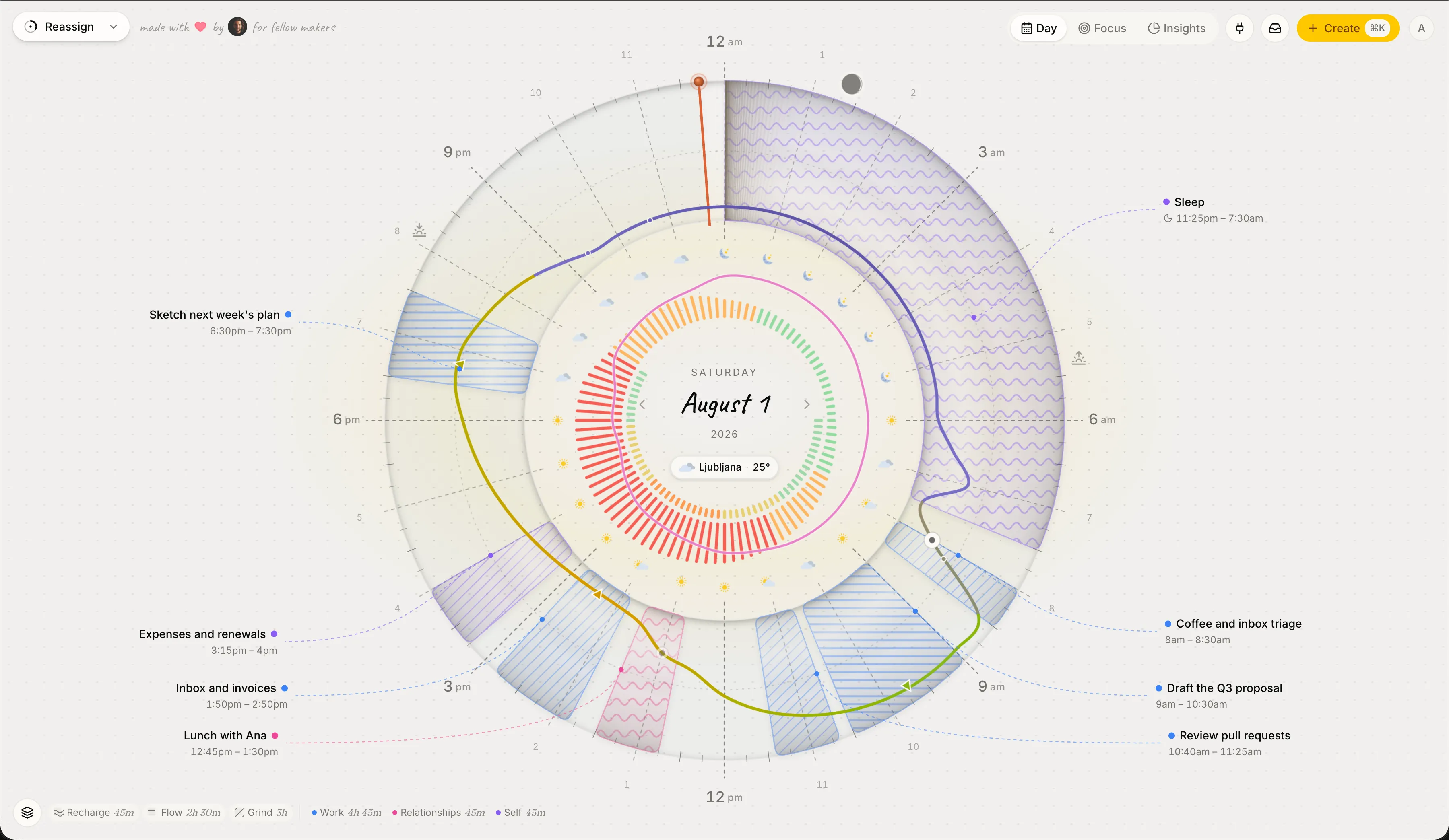
Two details matter more than the headline, and both come from the same design decision.
Sleep debt flattens the curve, and the app models that. Accumulated debt does not just pull the line down, it shrinks the gap between your peaks and your troughs. This is why the plan-for-your-peak advice stops working during a bad stretch: there is less peak to plan for. Seeing the curve go flat is a more useful signal than seeing it go low.
A gap in your log is not counted against you. In the rolling sleep-debt window, a missing night in the middle of the window drops out of the calculation rather than being scored as zero sleep. That is deliberate. A model that punishes you for not logging becomes another thing to keep up with, and that is how planners die. Last night is the one exception, because it is the night today’s curve is drawn from: leave that one unlogged and there is nothing for the layer to read. There are no streaks here, no badges, and no number that turns red.
The layer needs one logged night to draw. Not two weeks of history, not a calibration period. Log last night, and today’s line appears.
What it does not do: measure anything. The energy on the dial is modelled, not measured, and it will be wrong sometimes. It is a better starting guess than an empty column, which is the honest size of the claim.
The full account of how the layer is built, and what it looks like on the dial, is in the piece on the energy curve itself.
What to try this week
Write down when you fall asleep and when you wake, for four nights. Find the midpoint. That is your anchor, and it costs you nothing but a note on your phone.
Then move one block. Take the most demanding thing in your week, and put it in the second half of your morning as measured from your wake time, not from nine o’clock. Give the hour three or four hours after that to the admin you have been avoiding.
If it goes badly, you have learned your curve sits somewhere else, which is also worth knowing. If it goes well, you have found an hour that was always there.
None of this makes you have more energy. It puts the work where the energy already was, which is a smaller claim and a much more reliable one.
Try Reassign Pro free for 7 days, no card required. Draw one day and see where your hours fall.
Frequently asked
- What is ADHD energy management?
- It is the practice of planning around the energy you will actually have rather than the hours that happen to be free. Most ADHD energy advice covers quantity: how much you have, and how to avoid spending it all by Tuesday. Spoon theory and energy audits sit here. The half that usually goes missing is timing: energy is not a fuel tank that drains evenly, it is a curve with peaks and troughs at particular hours, set mostly by your body clock and by how long you have been awake. Managing it well means knowing both, and putting demanding work where your curve is high instead of where your calendar is empty.
- Why do I have more energy at night if I have ADHD?
- Because your body clock is probably running late. Circadian phase is anchored to your habitual sleep timing, and ADHD is strongly associated with a delayed one. Estimates of delayed sleep phase in adults with ADHD range from about 26% by self-report, against 2% of matched controls in the same study, up to 78% when measured directly by melatonin timing. A late clock shifts the whole curve right, so the alert hours other people get in the morning arrive for you in the evening. The late-night focus is not a discipline failure. It is your peak landing at the hour the world stopped asking anything of you.
- Why am I more productive at night with ADHD?
- Two things stack, and only one of them is about you. The first is the body clock: ADHD is strongly associated with a delayed circadian phase, so the evening lift that most people get around six can arrive for you at ten or eleven, which means you are genuinely at your sharpest when everyone else has stopped. The second is the room. Late evening has fewer interruptions, less sensory load, no messages arriving, and nothing left to decide, so the same brain meets a far cheaper environment. The cost is that spending the late peak pushes your sleep later, which shifts tomorrow's curve later again, so it works occasionally and gets expensive as a habit.
- Is spoon theory the same as energy management?
- No. Spoon theory is a quantity model: you start the day with a limited number of spoons, each task costs some, and when they are gone they are gone. It is genuinely useful for pacing and for explaining limits to other people. What it does not do is tell you when your spoons are. Two identical tasks cost very different amounts at 10am and at 3pm, and a quantity model has no way to say so. Timing is the missing half, and it is the half a body-clock model answers.
- How do I find my peak energy hours without a fitness tracker?
- You need one number, which is the middle of your sleep. Take the time you actually fall asleep and the time you actually wake, and find the midpoint. That mid-sleep point is the standard marker chronotype research uses, and your alert hours sit at a fairly predictable distance from it. You can do this on paper over three or four nights, ideally including days with no alarm, since an alarm truncates the real signal. No wearable measures your energy anyway. Devices measure sleep and movement, then model the rest, which is exactly what you can do from a number you already know.
- Why do I crash in the afternoon?
- Partly because everyone does. Alertness is biphasic rather than a single hump, so a real dip falls in the early afternoon between a late-morning peak and an evening second wind. It is a property of the body clock, not of your lunch. With ADHD there can be a second cause layered on top, which is stimulant medication wearing off, and that one follows your dose timing rather than your body clock. If your crash lands at the same clock time every day regardless of sleep, that is a conversation for your prescriber, not for a planner.
- Does ADHD change your chronotype?
- The association is well established: ADHD is consistently linked with evening chronotype and with delayed sleep timing, and reviews have argued that a subgroup of ADHD is best understood as a circadian rhythm problem. Be careful with the direction of that claim. The evidence supports a strong association in a subgroup, not the statement that ADHD simply is a circadian disorder. What it means practically is that generic advice like schedule deep work for 10am is built on an average that a large share of ADHD readers are not on.
- What should I do on a low energy day?
- Reduce the demand rather than the ambition. Sleep debt does not only pull the whole curve down, it flattens it, so the gap between your good hours and your bad ones shrinks and the usual trick of saving hard work for your peak stops paying. On a flat day the honest move is to pick one demanding thing instead of three, put it in what is left of your best window, and give everything else to the trough. Trying to run a normal plan on a flattened curve is how a bad night becomes a bad week.
- Can a planner app actually help with energy management?
- Within limits. No app measures your energy, and any that claims to is modelling it from sleep and movement like everyone else. What a planner can do is make the timing visible while you are deciding, so the question stops being which hour is free and becomes which hour can carry this. Reassign's Energy layer, which is part of Pro, draws a per-hour curve around its 24-hour dial, modelled from a two-process circadian and sleep-pressure model and bent by the sleep, caffeine, and naps already on your day. It needs no wearable and draws from a single logged night.
- When is the best time of day for deep work?
- For most people alertness climbs through the morning to a late-morning peak, dips after lunch, and lifts again in the early evening, so late morning is the natural slot for hard focused work and the early-afternoon trough suits admin. Your exact curve depends on your sleep timing and chronotype, and if your clock runs late, as it does for a large share of people with ADHD, every one of those windows shifts later. Reassign's Energy layer draws your own curve hour by hour so you can place deep work on your peak rather than the average one.
- What is the two-process model of sleep and alertness?
- It is the standard sleep-science model of why you feel sharp or foggy. Process C is your circadian rhythm, a body clock that raises and lowers alertness on a roughly 24-hour cycle. Process P is sleep pressure, which builds the longer you are awake and discharges when you sleep. Alertness is the circadian lift minus the weight of sleep pressure: a continuous curve across the day rather than a level that drains. Reassign draws that curve around its 24-hour dial and bends it to your real sleep, caffeine, and naps.