The best hour to study is on your clock, not the timetable's
When is the best time to study? It depends on your chronotype. How time of day affects studying, why students run late, and how to find your hours.

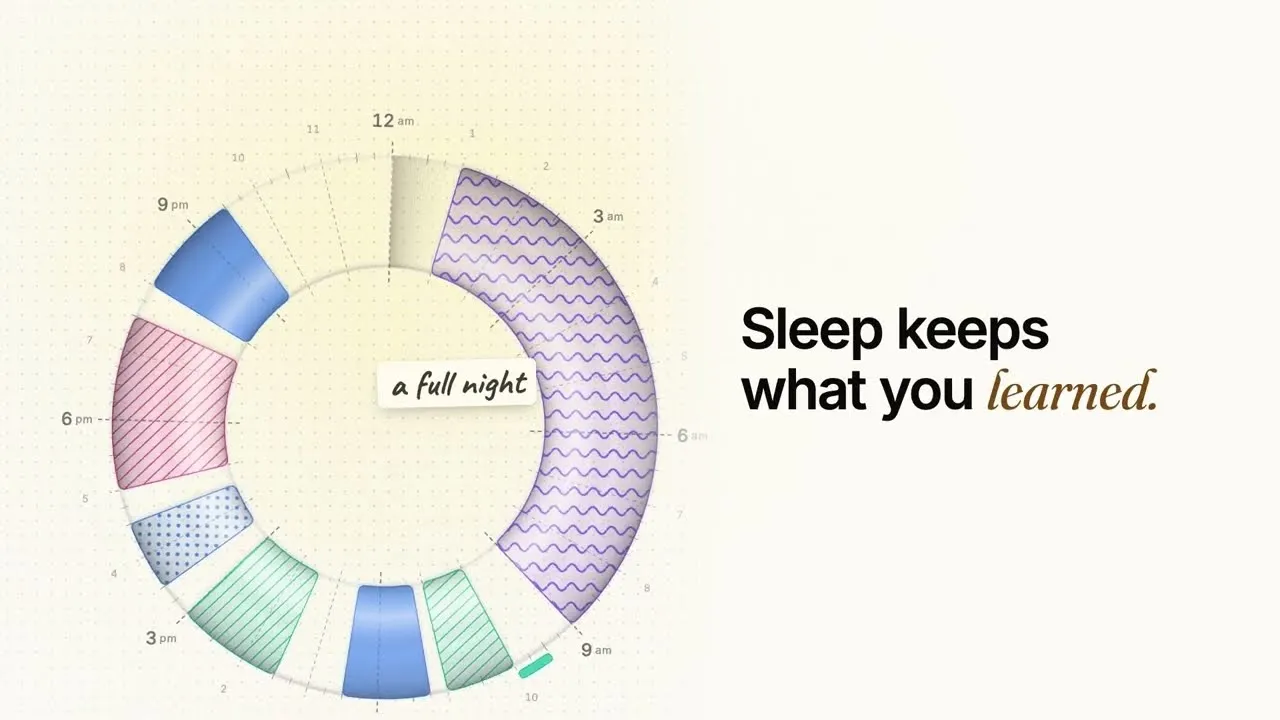
There is no single best time to study. The best time is the few hours when your body clock has you most alert, and for most students those hours come later than the timetable assumes.
I build Reassign, a 24-hour day planner with an energy curve on it, so I have a bias toward “plan around your clock”. I have tried to keep this post to what the research actually shows, with the papers linked. Where the evidence is thin, I say so.
When is the best time to study?
The honest answer is: at your own peak, and your peak depends on your chronotype. Chronotype is where your body clock sits in the day. Early types are sharp early. Late types warm up later. Most people sit between.
The idea that the match matters has a name: the synchrony effect. In a 1993 study, May, Hasher, and Stoltzfus tested the memory of younger and older adults in the morning and in the late afternoon. Most younger adults were evening or neutral types, and most older adults were morning types. In the late afternoon, the younger group did clearly better. In the morning, when the older group was at its peak, the age difference in memory was gone.
A later review of circadian research in cognition, by Schmidt, Collette, Cajochen, and Peigneux (2007), came to the same place on a wider base. Time of day affects attention, executive function, and memory. How much it matters depends on the synchrony between your peak and the hour of the task.
So “study in the morning” is advice for morning people. It is not a law.
Does time of day affect studying?
Yes, and not only in the lab. Two student studies are worth knowing.
Argentina, 2020. Goldin and colleagues followed 753 secondary-school students who were randomly assigned to start school in the morning (07:45), the afternoon (12:40), or the evening (17:20). In morning school, early chronotypes did better than late ones in every subject, and the gap was largest in maths. In afternoon school, the gap was gone. Late chronotypes did better with evening classes. Random assignment is what makes this study strong: the students did not choose their shift.
Illinois, 2018. Smarr and Schirmer used two years of learning-system logins from 14,894 university students to estimate each one’s daily rhythm. The majority had more than 30 minutes of social jet lag on average, the gap between the body clock and the class schedule. More of it went with lower grades, most of all in later chronotypes. This is a correlation, not proof of cause, but it points the same way as the Argentina result.
You will see sites quote a precise number for how much more you remember at the “right” hour. I have not found one that holds across ages, tasks, and schedules, so I do not print one here. The direction is well supported. A single figure for your own study is not.
Why do students feel awake at night?
Because your clock probably runs late, and that is normal at your age.
A large European survey by Roenneberg and colleagues (2004) found that chronotype gets later through adolescence, reaches its latest point around age 20, and then turns earlier again. The authors suggest that turn could mark the biological end of adolescence. A review by Crowley, Acebo, and Carskadon (2007) covers the same delay in sleep and body-clock timing through adolescence.
So when the 9am lecture feels like it happens at dawn, for your body it partly does. That is not laziness. It is a clock that has not yet swung back.
The catch is the weekend. Late types build a sleep debt on class days and pay it back on free days. Wittmann, Dinich, Merrow, and Roenneberg (2006) named that gap social jet lag. They found the links between chronotype, wellbeing, and stimulant use were strongest in teenagers and young adults up to age 25.
Is it better to study in the morning or at night?
It depends on your clock, with one firm limit: sleep.
If you are a late type, an evening block can be a real peak. Use it. But sleep is part of studying, not a break from it. A review by Diekelmann and Born (2010) describes sleep as a state that helps to consolidate newly learned information in memory. Study at 11pm and then sleep a full night, and you keep the benefit. Study until 4am before a 9am exam, and you spend the sleep that would have done the consolidation.
There is a second cost. A late night pushes your sleep later, which shifts tomorrow’s clock later again. Once in a while, that is fine. As a habit, it widens the gap with your class schedule.
If you are an early type, the morning is yours. Protect it from the inbox, and give the late afternoon to lighter work.
How do I find my best time to study?
You need one number: the middle of your sleep. You do not need a wearable. Try these six steps this week.
- Log a few nights of sleep. Write down when you fall asleep and when you wake, for four nights. Include days without an alarm if you can, because an alarm cuts the real signal short.
- Find your mid-sleep point. Take the midpoint between sleep and wake. Asleep at 1am and awake at 9am gives 5am. That is the chronotype marker researchers use.
- Draw your curve. Enter your usual bedtime and wake time in the free circadian rhythm calculator. It draws a predicted morning peak, afternoon dip, and evening peak on a 24-hour dial, in your browser, with no account. It is a prediction, not a measurement.
- Put the fixed things on first. Classes, labs, shifts, travel, sleep. Then look at which free gaps fall on your peaks. Our guide to time blindness in college has a worked study day with buffers.
- Put the hardest study on a peak. New material, problem sets, and essay drafts go on a peak gap. Flashcard review, reference lists, and email go in the dip.
- Check a week and adjust. After each block, note if it went well or badly. If your good sessions keep landing an hour later than the curve said, trust the week, not the curve.
Why mid-sleep is the anchor, and how the curve moves with ADHD, is covered in the piece on ADHD energy management. I will not repeat it here.
What if my best hours clash with my timetable?
They often will. You cannot move a 9am lecture, and the Argentina study shows a school shift can cost late types. What you can move is the study around it.
- Use the lecture as the low-effort part. Listen and take notes in the early slot. Save the hard reading from that lecture for your peak later in the day.
- Protect one peak block a day. Put one demanding study task in a gap when you usually feel alert. Book it before the day fills up, then check what you got done and adjust the next block.
- Give the dip a job. The early afternoon is a poor time for new proofs and a fine time for admin. Knowing that ahead of time stops you from reading a slow hour as a bad day.
- Keep sleep regular across the week. A smaller gap between class days and free days means less social jet lag to pay back on Monday.
If you want the wider case for planning by energy and not only by free time, read energy management vs. time management. This post is only the study part.
Where Reassign fits
Reassign draws your day as one 24-hour dial. Classes, study, work, and sleep sit on the same ring, each block sized to its real length. The energy curve draws your predicted alertness round that ring, so you can see which free gap sits on a peak and which sits in the dip. How that curve is built is in energy-based planning.
The rail I hold it to: the curve is a prediction, not a measurement. It is built from your own logged sleep and what you log through the day, it needs one logged night to draw, and it can be wrong. It is a better first guess than an empty column. It does not tell you how you feel.
The energy curve is part of Pro. Pro is $14 a month or $120 a year, and new accounts get 7 days of Pro with no card required and no automatic charge. The circadian rhythm calculator and the printable 24-hour planner stay free. If you are still choosing a planner for the term, see how to choose an ADHD student planner.
Try one peak block this week
Find your mid-sleep point. Pick the one piece of study you dread most this week. Put it on your next peak, not in the next free hour.
If it goes badly, you have learned where your peak is not. If it goes well, you found an hour that was always there.
Start your 7-day trial, no card required, and put tomorrow’s study on the dial.
Frequently asked
- When is the best time to study?
- There is no single best clock time for everyone. The research points to a personal answer: you tend to do demanding mental work best during your own peak hours, and those hours depend on your chronotype. For many students, whose body clocks run later than the school or university day, that peak comes later than an early lecture assumes. Find your peak from your sleep timing, then put your hardest study there.
- Does time of day affect studying?
- Yes. A review of circadian research in cognition (Schmidt and colleagues, 2007) found that time of day affects attention, executive function, and memory, and that the effect depends on whether you are tested at your own peak. The same review calls this synchrony between your peak and the task. In a randomised school study in Argentina, late chronotypes did worse in morning classes and benefited from evening classes.
- Is it better to study in the morning or at night?
- It depends on your chronotype. Early types tend to be sharpest in the morning, and late types later in the day. Most students lean later than older adults, because the body clock drifts later through adolescence and is latest around age 20. Night study only works if you still get the sleep afterward, because sleep helps to consolidate what you learned. An all-nighter spends that sleep.
- Why am I more awake at night when I try to study?
- Probably because your body clock runs late, which is normal at student age. Chronotype gets later through the teenage years and reaches its latest point around age 20 before it turns earlier again. So an evening lift is a real feature of your clock, not a lack of discipline. The cost is that a late night pushes your sleep later, and a short sleep flattens tomorrow.
- How do I find my best time to study?
- Start from your sleep. Note when you fall asleep and wake for a few nights, best on days without an alarm, and find the midpoint. That mid-sleep point is the chronotype marker researchers use. The free Reassign circadian rhythm calculator takes your usual bedtime and wake time and draws the predicted morning peak, afternoon dip, and evening peak on a 24-hour dial. It is a prediction, not a measurement, so check it against a real week of study.
- Is there a proven percentage for how much better you remember at your peak time?
- Not one number you can carry to your own study. Studies measure different tasks, ages, and schedules, so any single retention percentage you see quoted without a source should be treated with care. What the research supports is the direction: performance on demanding tasks tends to be better at your peak than off it, and sleep after learning helps memory.