How to plan your study week, and keep it when Tuesday goes wrong
Plan your study week in six steps: fixed commitments first, honest block sizes, one protected deep block, hard work at your peak, buffer, and a restart rule.

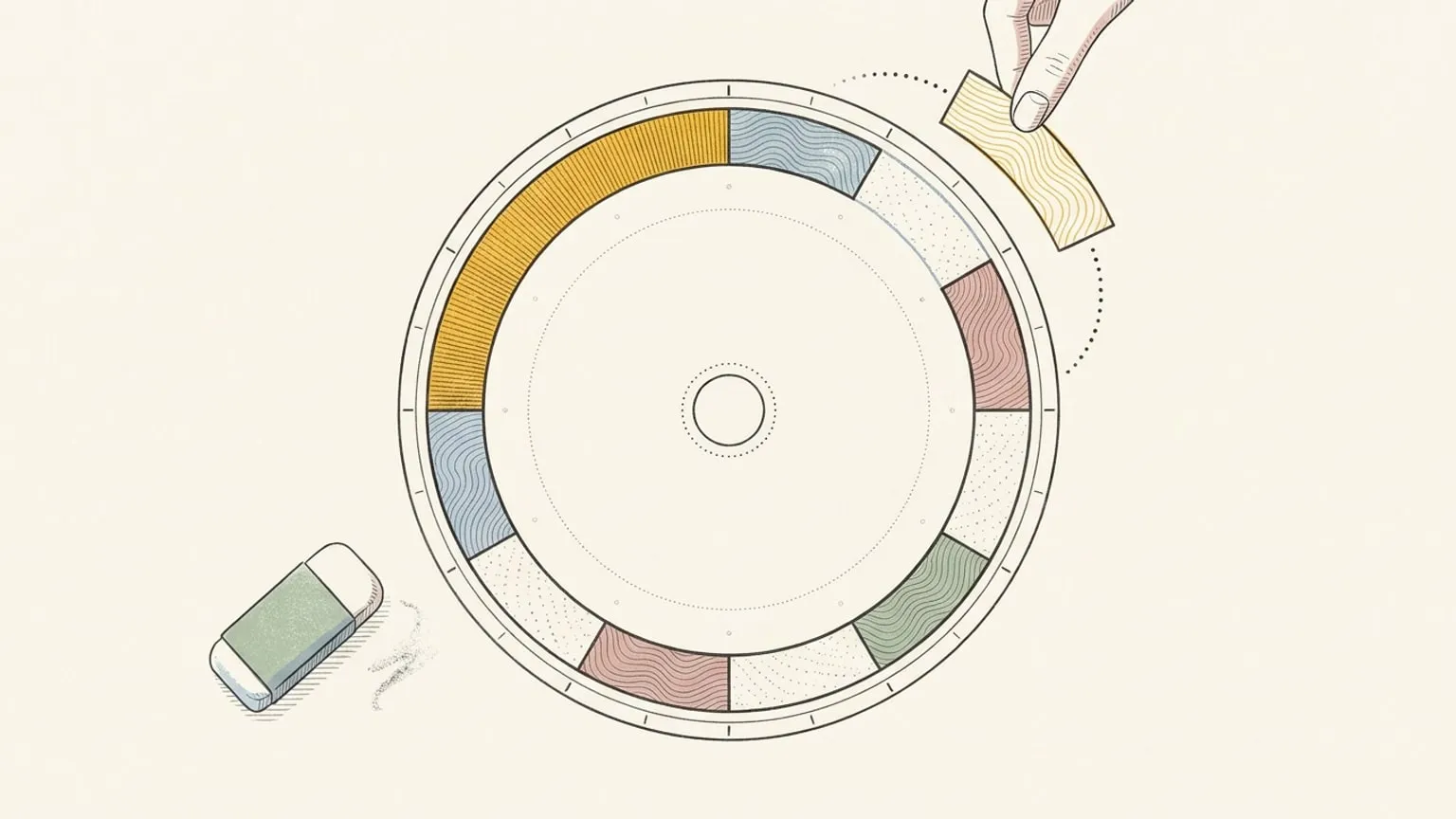
To plan your study week, put every fixed commitment down first, then fit study blocks into the gaps using how long the work took last time. Protect one deep block, leave empty hours, and when a block is missed, move it instead of starting over.
That is the whole method. The rest of this guide is the detail, plus a sample week with a bad Tuesday. I make Reassign, so the product mention at the end is mine. Everything before it works on paper.
Why does a weekly study schedule fall apart?
Study schedules often fail in the same place: they describe the week you hoped for. Every reading takes an hour. Every evening is free. Nothing runs late.
If you have ADHD or time blindness in college, the gap between hope and reality is wider. A chapter planned for an hour takes the afternoon. A deadline six weeks away feels like no deadline at all. By Wednesday the plan is fiction, and fiction is easy to abandon.
The fix is not a stricter plan. It is a more honest one, with room to move. This is time blocking applied to a week of study, so read that guide for the method itself.
How to plan your study week in six steps
Set aside twenty to thirty minutes at the start of the week. Use paper, a calendar, or a dial.
- Put fixed commitments down first. Classes, labs, seminars, shifts, travel, meals, and sleep, for all seven days. Do this before any study goes in. Now you can see the real gaps, and how small some of them are.
- Size study blocks from last time’s real duration. If the last problem set took three hours, book three hours. Not the ninety minutes you wish it took. Research on the planning fallacy found that people predicting completion times focused on their plans rather than on how long similar tasks took before. That research was not about ADHD, but the lesson carries: check your estimate against experience. If the work is new, book a short first session and write down how far you got.
- Protect one deep block. Pick one longer block this week for the hardest piece of work: the essay draft, the proof, the lab report analysis. Give it a specific goal, such as “write the method section”. Treat it like a class. One protected block that happens beats five that do not.
- Put hard study at your energy peak. Place demanding study in hours when you usually think clearly, where your timetable allows. A free slot at 4pm after three lectures may suit admin, flashcards, or tidying notes better. Energy-based planning goes deeper on this.
- Leave buffer. Keep some hours in the week with nothing assigned. They absorb the lecture that ran late, the reading that doubled, the day you felt awful. Start with a few hours and adjust from what the week actually needed.
- Reschedule instead of restarting. A missed block gets a new time this week. You do not rebuild the plan from Monday, and you do not wait for next week to “start fresh”. Move the block, check the deadline, keep going.
For assignments weeks away, work backward from the deadline and put one dated step in this week. The student time blindness guide shows how to give a term that shape.
How should you spread study across the week?
Spread each subject across several shorter sessions instead of one long one. A 2013 review of ten learning techniques rated two as high utility: distributed practice (spacing study out over time) and practice testing (quizzing yourself). It rated rereading and highlighting as low utility.
That review was not about ADHD. It still gives the week a rule: book three one-hour sessions of statistics on three days, not one three-hour session the night before the quiz. Where a session is a review, make it a self-test, not a reread.
A sample study week, with a bad Tuesday
This is an illustrative week for a second-year student with classes, a part-time shift, and one essay due in three weeks. Adapt the hours to your own timetable.
| Day | Fixed commitments | Study blocks |
|---|---|---|
| Monday | Lectures 9:00–12:00 | 13:30–15:00 Statistics problem set, part 1 · 15:30–16:30 Essay: read two sources |
| Tuesday | Seminar 10:00–12:00 · Shift 17:00–21:00 | 13:00–14:00 Statistics self-test · 14:15–15:15 Seminar reading |
| Wednesday | Lab 9:00–12:00 | 13:30–16:30 Deep block: essay, write the argument outline |
| Thursday | Lectures 11:00–13:00 | 9:00–10:30 Statistics problem set, part 2 · 14:00–15:00 Lab write-up notes |
| Friday | Lecture 10:00–11:00 | 11:30–12:30 Essay: read one source · 13:30–16:30 Buffer, nothing assigned |
| Saturday | Shift 10:00–16:00 | None |
| Sunday | None | 18:00–18:30 Plan next week |
The deep block goes on Wednesday afternoon because it is the longest free stretch on a day with no shift. The problem set is split across Monday and Thursday because the last one took three hours, not one. Friday afternoon has no job except catching overruns.
Tuesday goes wrong
The seminar runs until 12:30. Lunch takes longer. At 14:00 you have not started the self-test, and the shift starts at 17:00.
Do not try to catch the whole plan up. Move the statistics self-test to 14:00–15:00 and move the seminar reading to Friday’s buffer, 13:30–14:30. The shift, the deep block, and the rest of the week stay where they were.
Now say Wednesday’s deep block also slips, because you slept badly. Move it to Friday 13:30–16:30 and push the seminar reading to Sunday afternoon. The buffer is gone for this week. That is its job. If a third thing slips, reduce scope: outline two sections instead of four.
At the end of the week, note what each block actually took. The problem set took 3.5 hours this time? Book 3.5 next week. That record is how the next plan gets more honest. Our guide to planning your day with ADHD covers the same move at day scale, including what to do when a whole morning disappears.
Try the week on paper first
You can run this whole method on paper. Print the free 24-hour planner, no signup, and draw one day per sheet. Fixed commitments first, then study blocks drawn to their real length. A three-hour block takes three times the space of a one-hour block, which makes an overloaded day hard to miss.
If you want help choosing a tool for the whole term, how to choose an ADHD student planner compares paper, timetable apps, calendars, and a dial, with what each does not do.
Where Reassign fits
Reassign puts that 24-hour dial on screen. Drag to draw a study block, drag it to a new slot when Tuesday goes wrong, and see the current hour with the now indicator. Classes already on Google Calendar or Outlook Calendar sync two-way, and so do tasks from Todoist, Google Tasks, Microsoft To Do, Linear, and TickTick. Calendars you do not own show as read-only, and university ICS-feed subscriptions are not supported yet.
It runs in any browser and installs to your phone’s home screen as a web app. The iPhone companion is being built. There are no streaks: a missed Tuesday resets nothing.
Reassign has one Pro plan: $14/month, or $120/year. There is no student discount. New accounts get 7 days of Pro with no card required and no automatic charge. Start your 7-day trial and draw this week’s fixed commitments first.
Frequently asked
- How many hours a week should I study?
- There is no single right number. Your course handbook or module guide often states the expected study hours, so start there. Then check the week you drew: if the hours do not fit around classes, work, and sleep, the plan needs fewer tasks, not less sleep.
- How do I make a weekly study schedule?
- Build it from real durations and leave empty hours. A schedule that assumes every block goes perfectly breaks on the first late lecture. Put fixed commitments in first, protect one deep block, and move missed blocks to a new slot instead of starting over.
- Should I study every day or in a few long sessions?
- Spreading study for one subject across several days tends to help retention more than one long session. A 2013 review of learning techniques rated distributed practice and practice testing as high utility. It was not ADHD-specific. Try shorter sessions on more days and see what you retain.
- When should I plan my study week?
- Choose a time you already have, such as Sunday evening or Monday morning before your first class. Twenty to thirty minutes is usually enough once the fixed commitments are in place. Check the plan briefly each evening and move what needs to move.
- Is there a student discount on Reassign?
- No. Reassign has one Pro plan at $14/month or $120/year, with a 7-day trial and no card required. The printable 24-hour planner is free, and it works for the whole method in this guide.